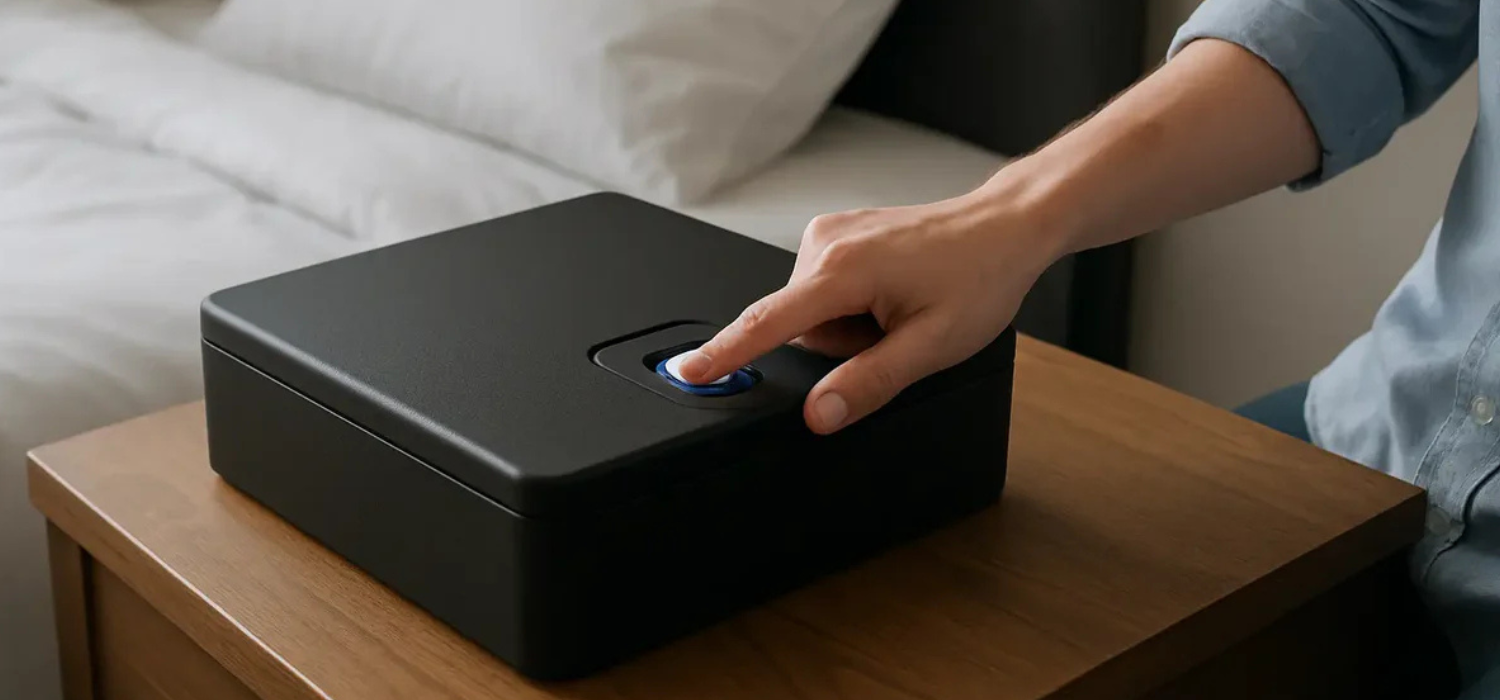
You can tell a lot about a bedside fingerprint safe by what happens at 2:07 a.m. when you are half-awake, the room is dark, and your hands are dry, sweaty, or cold. If the lid pops instantly and consistently, you will trust it. If it hesitates, demands a perfect finger angle, or beeps you into a lockout, it stops being “quick access” and starts being a problem.
This is why the “best bedside fingerprint safe” is not a single model for every home. It is the safe that fits your layout, your access needs, and your tolerance for trade-offs like size vs concealment and speed vs redundancy. Below is what to prioritize, what to avoid, and how to choose with the same logic we use when we help customers match a safe to their use case.
What “best bedside fingerprint safe” really means
Most people shopping this category want three outcomes at the same time: fast access for an authorized user, responsible denial of access to kids or guests, and enough physical protection that the safe is not simply carried off. A biometric bedside safe can do the first two well. The third depends heavily on mounting and construction.
Fingerprint access is about convenience under stress. But convenience only helps if the system is consistent. The best units are designed around repeatable finger reads, a motorized opening mechanism that does not bind, and an override method that still works if the battery dies or the scanner has a bad day.
The trade-offs you should accept (and the ones you should not)
It is normal for a compact bedside safe to be thinner steel than a full-size burglary safe. It is not normal for it to flex easily, have sloppy lid gaps, or use weak internal hinges that can be pried. Think of a bedside biometric safe as a quick-access device first, then add as much real physical security as your size and budget allow.
You should accept that biometric scanners can be picky with wet fingers, cuts, or lotions. You should not accept a safe that has no reliable backup entry, no low-battery warning, or a design that allows the entire safe to walk out of the room in seconds.
The four features that separate a good biometric bedside safe from a frustrating one
Speed and consistency of the biometric reader
Look for a reader that opens quickly and does not require “perfect placement.” Practical cues help - a scanner surface large enough to hit reliably in the dark, tactile indexing you can feel, and a layout that keeps your hand in a natural position.
Also pay attention to capacity. Many safes store multiple fingerprints, which matters if two adults need access, or if you want to enroll multiple fingers per user. Enrolling at least two fingers per person is smart because real life happens - bandages, small cuts, or a finger that is slightly swollen can change read quality.
A real backup entry method
Battery-powered bedside safes are normal. Being locked out is not. The best setups include redundancy: a PIN keypad you can use quietly, plus a mechanical override key for true emergency access.
If you keep an override key, store it where it is accessible to you but not obvious to a child or casual guest. That could be on a high shelf in a small lockbox, or secured in a separate location. The key is not a failure - it is insurance.
Interior fit for your firearm and your routine
A bedside safe has to fit your exact carry or home-defense setup. Handgun size, optics, weapon light, spare magazine, and even taller suppressor-height sights can change what works.
Pay attention to the opening style. A top-opening lid works well on a nightstand surface and keeps the firearm oriented consistently. A front-opening door can be better if you are mounting inside a drawer or beside the bed, but it needs clearance to swing open.
Interior lighting is not a gimmick if you actually use the safe at night. A small interior light helps you get the right grip and reduces fumbling.
Mounting options that prevent “grab-and-go” theft
This is the most overlooked part of the bedside category. A compact safe that is not anchored is a portable container. If someone can pick it up and leave, you have traded access control for delayed access control.
The best bedside fingerprint safe for most homes is one you can bolt down to a solid surface using pre-drilled mounting holes and included hardware. Nightstands vary widely in build quality, so consider your anchoring plan before you buy. A thin particle-board drawer bottom is not the same as anchoring into solid wood framing or a floor stud. If you cannot bolt down, a security cable is better than nothing, but it is still a compromise.
Construction details that actually matter at the bedside
Biometrics get the attention, but the box matters too.
Steel thickness is a practical signal. Thicker steel generally resists prying and deformation better, though design matters as much as gauge. A well-built lid with tight tolerances, protected hinges, and a solid locking mechanism can outperform a poorly designed thicker box.
Look closely at the lockwork. Some quick-access safes use spring-loaded latches; others use more secure locking bolts. For bedside use, you want a mechanism that is fast but not flimsy. If the safe includes anti-pry features like a recessed door/lid, that is a plus.
Also consider finish and noise. If you need discreet access, a safe that opens with a loud beep or a hard clank can be the wrong fit, even if the scanner is good. Many models let you mute keypad sounds, and soft interior lining reduces rattle.
Where to place a bedside fingerprint safe (and why it changes what to buy)
Placement affects speed, safety, and whether mounting is realistic.
On top of a nightstand is common and very fast, but it is also visible. If you go this route, prioritize a low-profile unit that sits cleanly and can be anchored. Inside a drawer offers concealment and can still be fast if the drawer slides smoothly and the safe opens without binding. Just be honest about clearance - drawers that barely open all the way can slow you down.
Some users mount a safe to the side of the bed frame or to a wall stud near the bed. This can be a strong solution for theft resistance and access, but it requires the right opening direction and the discipline to install it correctly.
If children are in the home, placement is about more than convenience. Your safe should be secured in a way that prevents it from being handled, moved, or experimented with. Quick-access should never mean “easy to play with.”
Who should not choose a fingerprint-only bedside safe
If you have very rough hands, frequent cuts, or work conditions that change your fingerprints, you may find a keypad-based quick-access safe more consistent. Biometrics can still work, but you should plan to use the PIN option often.
If you want meaningful burglary resistance - the kind you would trust against tool attacks - a small biometric bedside safe is not the same category as a heavier burglary safe or a TL-rated safe. For higher-threat environments or higher-value storage, it can make sense to use a bedside quick-access safe for readiness while storing other valuables in a heavier, anchored safe elsewhere.
How to evaluate a biometric bedside safe before you commit
When you are comparing models, picture a simple test: can you open it quickly with your non-dominant hand, in the dark, without looking? You will not always have ideal conditions.
Then focus on failure modes. What happens when the battery is low? Is there a clear warning? Is the battery compartment accessible without opening the safe (which would be impossible if it is dead)? Does the unit keep fingerprints stored when the battery is replaced?
Finally, look at ownership details that rarely show up in marketing photos: how easy it is to program multiple users, whether the safe has a lockout feature after failed attempts, and whether that lockout could become a problem for you in a real emergency.
If you want help narrowing down options across sizes and security tiers, Secure Zoned can walk you through fit, mounting, and lock preferences via call or text, and you can browse category-driven options at Secure Zoned.
A realistic “best” recommendation framework
Rather than naming a single winner that might not fit your handgun, your nightstand, or your household, use this framework.
If your top priority is fastest access, choose a compact top-opening biometric safe with a proven reader design, interior lighting, and a quiet mode, then anchor it to a solid surface. If your top priority is reliability across changing conditions, choose a biometric safe that also has a fast keypad workflow and enroll multiple fingers per user so you are not dependent on one scan.
If your top priority is theft resistance, prioritize heavier construction and anchoring first, then treat biometrics as a convenience layer. The safe that cannot be removed is usually the safe that does its job.
The right answer is the one that you can open on demand, keep secured every day, and install in a way that makes theft and unauthorized access meaningfully harder. Choose for your real routine, not the perfect scenario, and you will end up with a bedside setup you can trust when it counts.