You should never be deciding where your handgun is while you're half asleep, hearing a bump in the night, and trying not to wake the whole house. That moment is exactly why quick access handgun safes exist - not as a "nice to have," but as a practical way to keep a defensive firearm both available and responsibly secured.
The challenge is that "quick access" can mean very different things depending on your home layout, who else lives there, and how you actually store and carry day to day. A safe that's perfect for a nightstand can be a poor fit for a living room, a vehicle, or a small apartment. Below is the buying guidance we give customers every day: how these safes work, where they fall short, and what matters most when you're choosing one.
What "quick access" really means
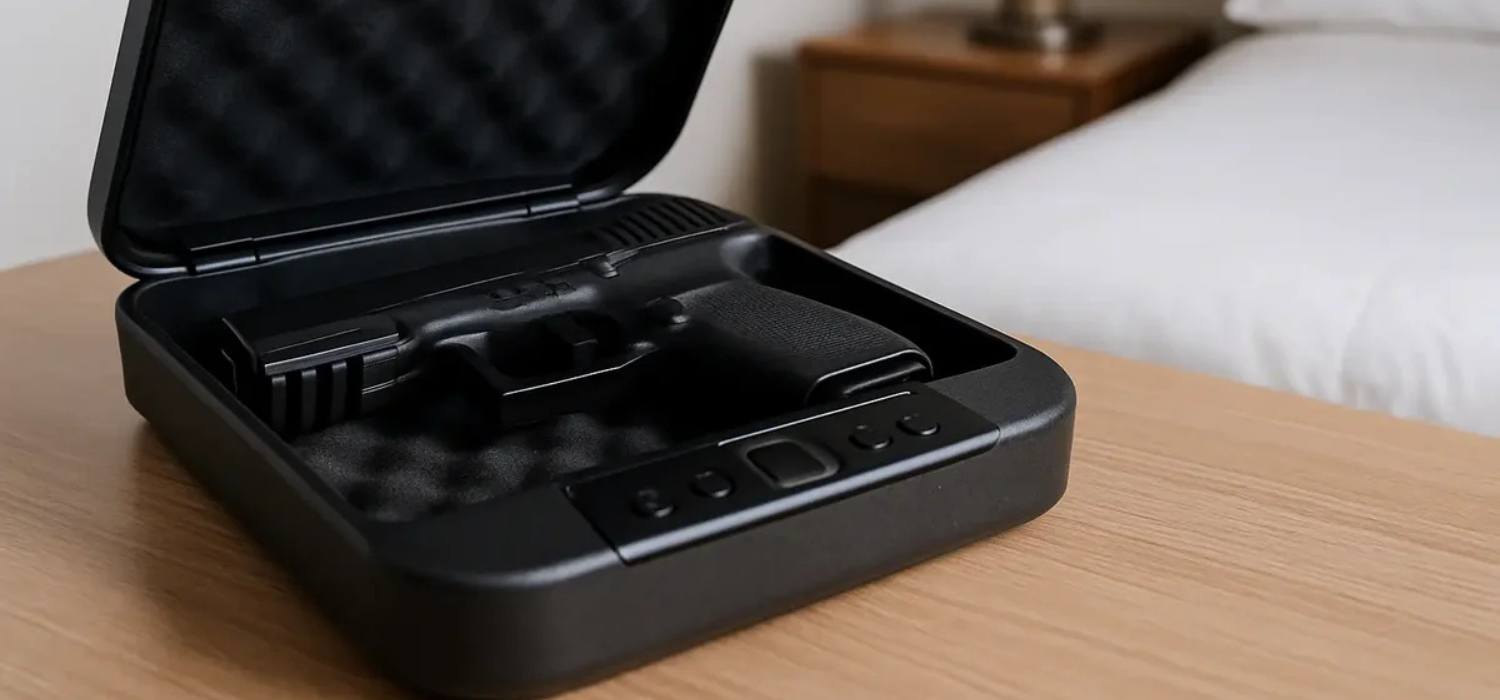
A true quick-access safe is designed for one job: get you to a single handgun fast, without leaving it exposed to children, guests, or an opportunistic theft. Most models are compact, open from the top or front, and use a fast lock method such as biometric, electronic keypad, or a mechanical push-button layout.
"Quick" should not mean "easy for everyone." If the safe is light enough to walk off with and not anchored, or if the code is something a teenager can guess, it's fast access for the wrong person. The best setups treat speed and retention as a matched pair: fast for you, frustrating for anyone else.
Start with the risk you're actually managing
Most buyers are balancing three risks at once: unauthorized access (kids, visitors, roommates), theft during a break-in, and delayed access during an emergency.
If children are in the home, the safe's primary job is preventing handling. That pushes you toward a lock you can operate consistently under stress, plus a placement that isn't visible or reachable by a curious kid. If your bigger concern is burglary, anchoring and steel thickness matter more than shaving half a second off opening time. If your concern is bedside access, orientation and door swing matter more than raw capacity.
The right product is the one that matches the dominant risk - then you tune the rest.
Lock types: biometric, electronic, and mechanical
Most quick access handgun safes fall into three lock categories. Each can work well, and each has trade-offs.
Biometric: fast when conditions are good
Fingerprint safes are popular because they feel effortless: touch, open, done. In real life, performance depends on sensor quality and your fingerprint condition. Dry hands, worn prints from manual work, minor cuts, or moisture can slow you down. Many models allow multiple prints per user - using both thumbs and index fingers, from more than one angle, helps reliability.
The practical approach is to choose a biometric safe that also includes a keypad or key backup, then actually set up the backup. If you rely on biometric alone and it fails when you need it, you've traded security for uncertainty.
Electronic keypad: consistent and family-friendly
A good keypad safe is often the most predictable option. You can open it in the dark by feel once you practice. It also supports multi-user codes, which matters if two adults need access.
The weak point is battery dependency. Keypads are only "quick" if you stay ahead of maintenance. Look for a low-battery warning, easy external battery access (if offered), and a plan for replacement intervals. Many owners change batteries on a schedule - for example, at daylight savings time - rather than waiting for alerts.
Mechanical push-button: no batteries, strong muscle memory
Mechanical simplex-style locks (push-button sequences) are the workhorses of quick access. No batteries, no electronics, and very consistent operation. They can be louder than electronic options and typically don't log access events, but they shine when you want a device that just works for years.
If your priority is "works at 3 a.m. even if I forgot about it for six months," mechanical deserves a serious look.
Construction details that actually matter
Marketing tends to focus on how fast a door opens. What matters more is what happens when someone tries to defeat or remove the safe.
Steel thickness, door design, and internal hinges all affect resistance. A heavier unit generally buys you time, but weight alone isn't the whole story - a well-designed door with solid engagement points can outperform a lighter, poorly built box.
Also pay attention to the interior. Foam-lined interiors protect finishes, but they can also snag a tall front sight or a weapon light if the fit is tight. If you run an optic, compensator, or light, confirm the interior height and opening geometry. "Fits most handguns" often means "fits a standard pistol with no accessories."
Mounting and anchoring: the difference between a safe and a carry-away
A quick access safe that isn't mounted is a quick-to-steal safe. In a smash-and-grab, a thief doesn't need to open it - they just take it.
For home use, look for pre-drilled mounting holes and included hardware, then anchor it into something that can't be ripped out easily. Nightstand mounting, bedframe mounting, wall studs, and solid floor joists are common options depending on the safe design.
If renting limits drilling, you still have options: choose a heavier unit designed to be cabled to a fixed structure, or integrate it into furniture that's difficult to remove. This is one of those "it depends" scenarios where your living situation drives the best choice.
Placement: speed comes from repetition, not just proximity
Most people assume the best place is "as close as possible." The better rule is "close, consistent, and discreet."
Bedside placement is common because the access path is short and predictable. But it also gets the most foot traffic - cleaning, guests, kids climbing into bed, and curious hands. A safe mounted slightly out of sight (inside a nightstand, behind a drawer face, or on the bedframe) often improves both security and access because your hand goes to the same spot every time.
For daytime carry routines, consider where the handgun actually ends up when you come home. If it's set on a dresser "just for a minute," the safe isn't solving the real problem. A quick-access safe near the entry point or in the primary bedroom closet can be more effective than one that's technically closer to where you sleep.
One-gun vs multi-gun quick access
Capacity sounds simple, but it changes how you use the safe.
A single-handgun safe tends to open faster and guides the grip into a consistent position. It's ideal for bedside defensive use. A larger quick-access safe can store a handgun plus spare magazine, flashlight, and small valuables, but interiors can get cluttered. Clutter slows retrieval and increases the chance of snagging.
If you choose larger capacity, keep the defensive handgun in a dedicated, repeatable orientation. Treat the rest of the space like a secondary compartment, not a catch-all.
Realistic expectations: what these safes do and don't do
Quick access handgun safes are not the same thing as a full-size gun safe or a TL-rated burglary safe. Their job is controlled access and basic theft resistance, not defeating a prepared attacker with tools.
That doesn't make them "bad." It makes them purpose-built. A compact quick-access unit is often the right first step for responsible home storage, and it pairs well with a larger long-gun safe or higher-security safe elsewhere in the home.
If you want higher burglary resistance for handguns, consider stepping up to heavier construction, better pry resistance, and stronger mounting options - and accept that "quick access" may become "fast enough" instead of instantaneous.
Features that can help - and when they don't
Interior lighting is genuinely useful if you need to confirm grip and orientation in low light. But light should not be a substitute for learning the safe by feel.
Silent modes, tamper alerts, and lockout timers can be helpful in family homes, especially to discourage code-guessing. The trade-off is complexity. If a feature makes the safe harder to open when you're stressed, it's not a benefit.
Key overrides are common. If you use a key backup, store it responsibly. A key taped to the underside of the nightstand is not a backup plan - it's a vulnerability.
A simple way to choose the right model
If you want the decision to feel straightforward, decide in this order: where it will be mounted, how you want to open it under stress, and what handgun setup must fit (light, optic, spare mag). Only then compare construction, battery approach, and extras.
When shoppers want hands-on guidance based on their layout and risk priorities, our team at quick access handgun safes at Secure Zoned typically narrows options quickly by asking a few practical questions: Who needs access, where will it live, and will it be anchored? That short conversation prevents the common mismatch of buying a "popular" safe that doesn't fit how you actually live.
The closing thought
The safest quick-access setup is the one you can operate correctly every single time, with a mounting plan you won't skip and a placement you won't drift from. Pick the safe that supports your routine, then practice with it until "secure and fast" feels automatic.