
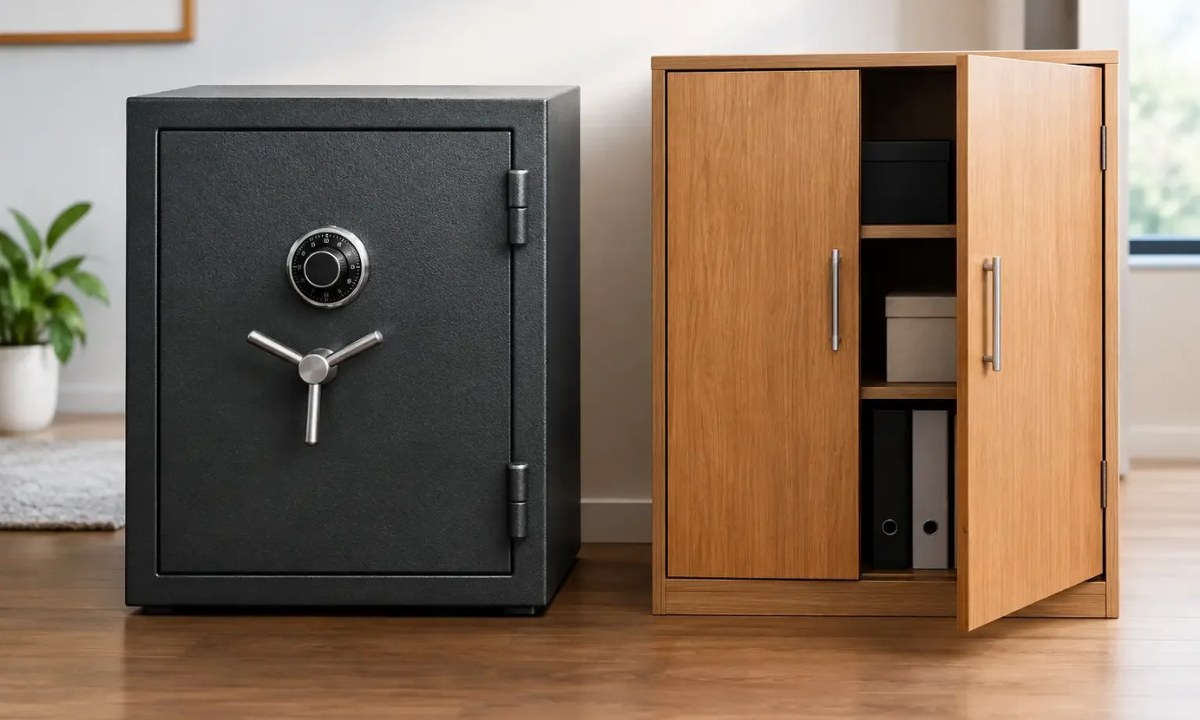
A burglary safe versus cabinet decision often comes down to one uncomfortable question: how long do you need your property to resist a determined thief? A locking cabinet can keep everyday items out of sight and away from curious hands. A true burglary safe is designed to delay forced entry with heavier construction, more secure locking components, and the ability to be anchored in place.
Both have a role. The right choice depends on what you are protecting, where it will be installed, and whether the primary concern is access control, theft resistance, fire protection, or all three.
Burglary Safe Versus Cabinet: The Core Difference
A security cabinet is generally a metal enclosure with a lockable door. It may be useful for organizing firearms, tools, keys, files, or low-value inventory. Many cabinets use thinner steel and a simpler locking mechanism than a safe. They are usually lighter, less expensive, and easier to move into a home, office, or back room.
A burglary safe is built to make forced entry difficult and time-consuming. Depending on the model, that can include a thick steel body and door, solid locking bolts, a protected lock, hard plates that resist drilling, internal relockers, reinforced door frames, and predrilled anchoring holes. These features do not make a safe invincible. They give an intruder fewer easy options and buy valuable time.
That distinction matters because a cabinet often protects against casual access. A burglary safe is intended to provide meaningful resistance when someone brings pry bars, drills, cutting tools, or time to the job.
Weight and anchoring change the equation
A cabinet that is not secured can be removed from the building quickly, especially when it holds handguns, jewelry, cash, or compact valuables. Even a heavy safe should be anchored whenever the floor and installation conditions allow. Bolting a safe to concrete or a suitable structural surface prevents a thief from simply taking it somewhere else to attack it.
Weight alone is not a security rating, but it is a practical factor. A substantially built safe is harder to tip, carry, pry open, or load into a vehicle. It also requires a real delivery and installation plan. Measure doorways, hallways, stairs, flooring capacity, and the final location before ordering.
Construction Specs That Actually Matter
Marketing terms such as “heavy duty” can mean very different things. When comparing a cabinet and a safe, look past the finish, shelving, and exterior appearance. Ask what the door, body, lock, and boltwork are made to withstand.
Steel thickness is a good starting point. Cabinets frequently use lighter-gauge sheet metal. Better safes use thicker steel in the body and door, sometimes combined with composite barriers designed to slow drilling and cutting. A thicker door does not tell the whole story, but a large-looking cabinet with a thin door skin is not equivalent to a burglary-rated safe.
The lock matters, too. A quality electronic lock, mechanical dial lock, or biometric lock can provide dependable daily access when it is paired with a well-built door and bolt system. A lock by itself cannot turn a light cabinet into a high-security safe. Look for recognized lock listings, protected lock areas, and a secure boltwork design rather than focusing only on how the keypad looks.
For serious burglary protection, ratings provide a clearer benchmark. TL-15 and TL-30 safes are tested to resist professional attack for specified periods using a defined set of tools. These ratings are particularly relevant for businesses holding cash, high-value inventory, controlled substances, or sensitive records, as well as collectors with substantial valuables. They are a different class of protection from a basic residential safe or locking cabinet.
Fire protection is separate from burglary protection
A common buying mistake is assuming a fire-rated cabinet is also a strong burglary safe. Fire protection and burglary resistance are separate performance goals. A safe with an advertised fire rating may help protect paper documents during a residential fire, but that rating does not automatically indicate resistance to prying, drilling, or cutting.
Likewise, a burglary safe may have limited fire protection or none at all. If you are protecting passports, titles, estate paperwork, backup drives, family photographs, or business records, compare the stated fire rating, test conditions, and interior capacity. Paper, digital media, and firearms do not all have the same protection needs.
For irreplaceable documents, choose a model with fire protection that matches the likely risk and storage duration. For cash or jewelry, burglary construction and anchoring may deserve the higher priority. For many homeowners, a fire-rated burglary safe provides the most balanced answer.
When a Cabinet Is the Right Choice
A cabinet is not automatically a poor purchase. It can be a sensible solution when the goal is controlled access and organization rather than high-value theft protection.
For example, a locked cabinet may work well for storing cleaning supplies, tools, low-value equipment, office files, keys, or items that need to stay away from children and visitors. In a business setting, a cabinet can also support orderly access to supplies in a staff-only area where broader building security is already in place.
Gun cabinets deserve especially careful consideration. A locking cabinet can help prevent unauthorized handling, but it generally offers less resistance to theft than a purpose-built gun safe. Responsible firearm owners should consider the value of the firearms, the risk of smash-and-grab theft, whether children or guests may be present, and any applicable state or local storage requirements. A cabinet may be an interim option, while a properly anchored gun safe is usually the stronger long-term security choice.
Cabinets also make sense where weight and access are major constraints. A second-floor room, rental property, narrow stairway, or temporary workplace may not accommodate a 1,000-pound safe. Just be honest about the trade-off: convenience and lower cost typically mean lower forced-entry resistance.
When a Burglary Safe Earns Its Cost
Choose a burglary safe when the contents would be difficult, expensive, or impossible to replace. That includes firearms, jewelry, heirlooms, collectible coins, cash reserves, watches, sensitive documents, and small business valuables.
For a homeowner, a burglary safe provides more than a place to hide valuables. It creates a defined, controlled storage point that can be anchored and positioned away from obvious areas. For a gun owner, it can support responsible storage while protecting firearms from theft. For a business owner, it can limit exposure between bank deposits or provide a more secure place for valuable records and inventory.
A depository safe may be the better fit for a retail store, restaurant, or hospitality operation that receives cash throughout the day. Staff can make deposits without gaining access to the main cash compartment. A TL-rated safe may be appropriate when the dollar value and insurance requirements justify a higher level of tested protection.
The best safe is not necessarily the largest one. It is the one with enough usable interior space, an appropriate security level, a practical lock type, and an installation plan you will follow through on. Leave room for future needs. Safes tend to fill faster than expected once documents, valuables, accessories, and firearms are properly organized.
Installation Can Make or Break Protection
A strong safe in a poor location can still create problems. Avoid placing it where it is visible through windows or easily reached by a thief with direct garage access. Consider privacy, convenient daily access, and whether the floor can support the loaded weight.
Anchoring is one of the most valuable security upgrades available. Use the manufacturer’s mounting provisions and appropriate hardware for concrete or the approved structural surface. If you are uncertain about placement, floor construction, or moving a heavy unit, use experienced installers. An improperly moved safe can damage floors, walls, stairs, and people.
Also consider the environment. Basements, garages, and workshops may expose a safe to humidity or temperature swings. Elevating the safe slightly where appropriate, managing moisture, and using protective document containers inside can help preserve contents over time.
Choose for the Threat You Actually Face
The practical answer to burglary safe versus cabinet is not that everyone needs the most expensive safe available. It is that your storage should match the consequences of loss. If the main concern is basic access control and organization, a well-made locking cabinet may be enough. If theft would mean lost firearms, cash, heirlooms, confidential files, or a serious business disruption, step up to a burglary safe with the construction, rating, and anchoring plan to support that protection.
Before you buy, write down what will go inside, estimate its replacement value, and decide what kind of event concerns you most. That simple exercise usually makes the right level of protection much clearer.