
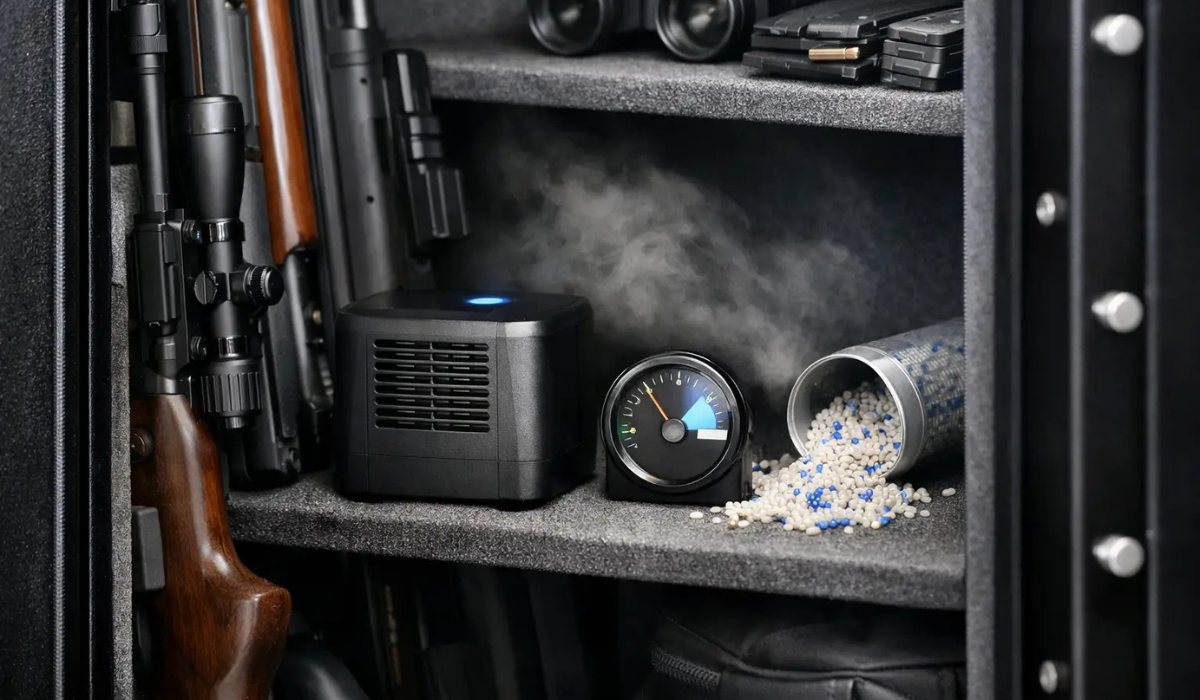
A gun safe can stop theft and limit fire exposure, but neither of those protections means much if moisture is quietly working on your rifles, handguns, optics, and documents every day. This gun safe humidity control guide focuses on the part of safe ownership that gets overlooked until rust spots, fogged glass, musty interiors, or swollen stocks show up.
Humidity problems inside a safe are common because safes are enclosed, heavy, and often placed in garages, basements, closets, or exterior-wall rooms where temperature swings are harder to control. When warm, humid air meets cooler steel, condensation can form. That is where corrosion starts, even in a well-built safe with a strong lock, thick steel, and a solid fire rating.
Why humidity inside a gun safe becomes a real problem
Firearms are made from blued steel, stainless components, springs, screws, and small internal parts that do not all resist moisture the same way. Add wood stocks, slings, paper records, and ammunition boxes, and you have a mix of materials that react differently as humidity rises. A safe does not create moisture on its own, but it can trap it.
The risk is not just visible rust. High humidity can degrade primers and powder over time, affect optics, damage leather accessories, and leave a stale odor that tells you moisture has been sitting too long. If you store suppressor accessories, magazines, backup documents, or cash in the same safe, those items can suffer too.
Most gun owners do not need laboratory conditions. They need stable conditions. In practical terms, a relative humidity range around 45% to 50% is a solid target for many gun safes. Go much higher and corrosion risk climbs. Go too low for long periods and some wood stocks and grips can dry out more than you want. That balance matters.
Gun safe humidity control guide: start with placement
Before buying a dehumidifier, look at where the safe sits. Placement affects moisture load more than many buyers expect. A safe in a climate-controlled interior room will usually be easier to manage than a safe in a garage or basement. Concrete floors are another factor because they can transfer cold and encourage condensation around the bottom of the safe.
If your safe is in a garage, especially in humid southern climates or in regions with strong seasonal swings, expect a harder fight. The same goes for basements with damp air or rooms near HVAC imbalance. In those setups, humidity control is not optional. It is part of responsible storage.
Raising the safe slightly off bare concrete can help. So can improving airflow in the room, running a room dehumidifier nearby, and avoiding installation against an exterior wall that stays cooler than the rest of the house. These are not glamorous fixes, but they work.
Active vs. passive humidity control
There are two main approaches inside a safe: active dehumidifiers and passive desiccants. The right choice depends on safe size, climate, and how often the door is opened.
Active dehumidifiers, often called golden rods or electric dehumidifier rods, warm the air slightly inside the safe. That small temperature increase helps reduce condensation and encourages circulation. They are a strong fit for larger gun safes and for owners in consistently humid regions. If your safe includes a power outlet kit or pass-through, this is usually the most consistent long-term option.
Passive desiccants absorb moisture. These include silica gel canisters, rechargeable desiccant packs, and moisture-absorbing containers. They are simple, affordable, and useful in smaller safes or as backup protection in larger ones. The trade-off is maintenance. Desiccants saturate and need to be recharged or replaced on schedule.
For many setups, the best answer is both. An electric dehumidifier handles ongoing control, while a desiccant pack helps buffer spikes when the door is opened or weather changes quickly.
How to choose the right solution for your safe
Safe size should drive your decision. A compact handgun safe in a bedroom closet may do well with a rechargeable desiccant pack and a humidity monitor. A full-size rifle safe packed with firearms, ammo, and gear usually benefits from an electric rod plus desiccant support.
Climate matters just as much. In Arizona, the challenge is different from Florida. In drier regions, passive control may be enough unless the safe is in a basement or near concrete. In high-humidity states, relying on a single small desiccant canister for a large gun safe is usually not enough.
Opening frequency changes the equation too. Every time the door opens, room air enters. If that room air is humid, the safe has to recover. Collectors, competitive shooters, and households that access firearms often should lean toward more stable, always-on control.
If your safe stores more than firearms - paper records, cash, passports, media, or heirlooms - be careful not to overcorrect. You want protection from moisture without creating conditions that are too dry for mixed contents.
Do not guess - monitor humidity inside the safe
A hygrometer is one of the most useful low-cost additions to any gun safe. Without one, you are making decisions based on feel, and that is not reliable inside an enclosed steel box.
Digital hygrometers are easy to read and help you spot trends. If the number spikes every time weather shifts or the door opens, you will know your current setup needs help. If humidity stays in a reasonable range, you know your combination of placement, dehumidifier, and desiccant is doing its job.
This also helps prevent overbuying. Some owners assume they need the biggest dehumidifier available when a properly placed rod and a small desiccant unit would handle the space just fine.
Common mistakes that lead to rust
One of the biggest mistakes is putting firearms into the safe after exposure to rain, range humidity, or temperature swings without wiping them down first. Even if the gun looks dry, residual moisture can stay in corners, under grips, around optics mounts, or inside soft cases.
Another common issue is storing guns in foam-lined or fabric cases inside the safe for long periods. Cases can hold moisture against metal. For long-term storage, it is usually better to place firearms directly on safe racks or organizers with proper spacing and airflow.
Overpacking the safe is another problem. Tight storage reduces air movement and creates microclimates where moisture lingers. If your safe is filled edge to edge, humidity control gets less effective.
Finally, do not treat rust prevention as a one-time task. Firearms still need routine inspection, a light protective oil where appropriate, and periodic cleaning. Humidity control lowers risk. It does not replace maintenance.
Gun safe humidity control guide for ammo, optics, and documents
A lot of safes hold more than guns, and each item has its own tolerance. Ammunition generally stores best in cool, dry, stable conditions. Humidity can damage packaging first, but over time it can affect reliability if storage conditions stay poor.
Optics can suffer from moisture intrusion, lens fogging, and corrosion around adjustment points or mounting hardware. If you have expensive scopes, red dots, or thermal accessories in the safe, stable humidity is worth the effort.
Paper documents, titles, cash, and photos can curl, discolor, or pick up odor. If your safe is marketed as fire-protective, remember that fire insulation and tight seals may also influence internal moisture behavior. That makes monitoring even more important, especially after delivery, relocation, or major weather changes.
What a practical setup looks like
For many homeowners, a practical setup is simple: place the safe in a conditioned part of the home if possible, keep it off bare concrete, add an electric dehumidifier rod sized for the interior, place a rechargeable desiccant unit on a shelf, and monitor the environment with a digital hygrometer. Then inspect firearms regularly rather than assuming the system is perfect.
If the safe must live in a garage or basement, step up the room-level control. A room dehumidifier may do more for long-term protection than adding larger and larger moisture absorbers inside the safe. Control the space around the safe, not just the interior.
If you are choosing a new safe and know humidity will be an issue, it makes sense to look at features that support accessories cleanly, such as outlet kits, interior organization that preserves airflow, and enough capacity so firearms are not crammed together. Secure Zoned carries gun safes, dehumidifiers, lighting kits, and organizers that make that kind of setup easier to build correctly from the start.
The goal is not to create a perfect lab environment. It is to give steel, wood, optics, and ammunition a stable place to stay ready, clean, and protected. A few small decisions now are a lot cheaper than refinishing rusted metal later.