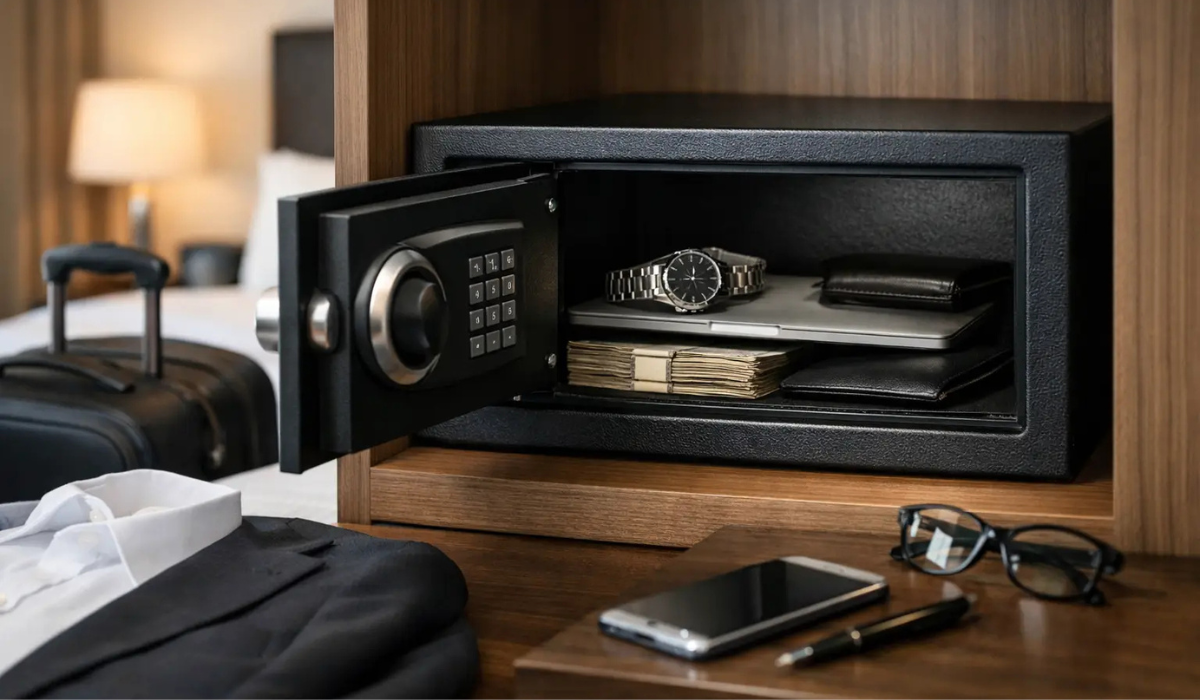
A guest misses checkout, calls from the airport, and says their passport, laptop, and cash were in the in-room safe. At that point, a hotel room safe for business is no longer a line-item purchase. It is part of your risk control, guest experience, and daily operations.
For hospitality operators, the right safe has to do more than hold valuables. It needs to be easy for guests to use without staff assistance, durable enough for constant turnover, and secure enough to reduce claims and tampering concerns. It also has to fit the room layout, your service standards, and your maintenance workload. That is why buying on price alone usually creates problems later.
What a hotel room safe for business really needs to do
An in-room safe serves two audiences at once. Guests want simple, private storage for passports, jewelry, wallets, medications, electronics, and travel documents. Management wants reliable hardware that limits liability exposure, supports housekeeping turnover, and does not create a steady stream of lockouts or battery-related service calls.
That tension matters. A safe that is highly secure but confusing to operate can frustrate guests and increase front desk involvement. A unit that is easy to use but lightly built or poorly mounted may invite tampering. The best fit is usually a commercial-grade hotel safe designed around repeat use, basic user instructions, and controlled override access.
In practice, that means looking at the whole system - the body construction, lock platform, mounting method, audit capability, and how staff reset or open the unit when a guest forgets a code.
Size matters more than many buyers expect
One of the most common mistakes is choosing a safe based on the smallest valuables a guest might store. That approach worked years ago when the typical use case was cash and a watch. It does not hold up well now.
Business travelers often carry larger laptops, tablets, portable drives, camera gear, and document folders. Leisure guests may still want space for passports and jewelry, but a business-friendly room safe should account for modern electronics. If a 15-inch laptop does not fit, the safe will feel inadequate even if it performs well in every other respect.
The room category matters too. Standard king rooms, extended-stay properties, executive floors, and suites may justify different capacities. A boutique hotel focused on short urban stays might prioritize compact under-desk installation. A business hotel near a convention center may need roomier units that handle electronics comfortably. It depends on your guest profile, not just your room count.
Lock type affects both security and service calls
Most hotel safes rely on electronic keypad locks because they are fast and familiar. That is usually the right direction for hospitality. Guests understand how to enter a code, close the door, and confirm lock status without much instruction.
Still, not all electronic locks are equal. Commercial buyers should pay attention to keypad durability, battery access, error handling, and override options. A lock that fails gracefully is much easier to manage than one that leaves staff improvising in front of a guest.
A good hotel lock setup should support emergency access by authorized staff while maintaining tight control over who can perform that override. Some properties prefer a manager code system. Others benefit from handheld override tools or software-based audit support, especially across larger portfolios. The right answer depends on property size and how centralized your operations are.
Biometric access sounds attractive on paper, but for hotel room use it is often unnecessary. Fingerprint readers can add complexity, create enrollment issues for one-night stays, and introduce more points of failure. For most hospitality environments, a proven electronic keypad with reliable override control is the cleaner choice.
Construction quality is where low-cost models separate quickly
A hotel room safe does not need the same burglary rating as a high-security cash safe or a TL-rated unit in a jewelry operation. But that does not mean construction should be treated casually.
Thin steel bodies, weak hinges, poor door fit, and low-grade locking components tend to show up fast in hospitality use. The unit gets opened and closed constantly. Housekeeping bumps it with vacuums or carts. Guests may force buttons, slam doors, or leave batteries drained. A cheap safe may survive occasional home use, yet fail early in a hotel environment.
Commercial operators should focus on steel construction, solid locking bolts, concealed or protected hinges where applicable, and a door design that resists prying better than basic consumer-grade boxes. Internal finish and shelf layout also matter more than they seem. A safe that scuffs electronics or catches on document corners creates friction for guests.
This is also one of those areas where recognized safe brands matter. Established manufacturers tend to offer better consistency in lock quality, replacement parts, and support documentation. That lowers long-term headaches for engineering and operations teams.
Anchoring and installation are not optional details
A hotel safe that is not properly mounted is a weak link, no matter how good the lock is. In-room safes should be anchored to a solid surface consistent with the manufacturer’s instructions and the room’s construction realities. That may mean floor mounting, wall mounting, shelf mounting, or cabinet integration with reinforced support.
What matters is resistance to quick removal. A thief does not always attack a safe in place. Sometimes they try to take the entire unit and work on it elsewhere. Proper anchoring changes that equation.
Installation location affects guest use as well. If the safe is buried too low in a cabinet, older guests and business travelers in a hurry may struggle with it. If it is too visible or poorly integrated, it can hurt the room aesthetic. The best placements balance discretion, access, and secure mounting. Under-desk cabinets, closet millwork, and credenza installations are common, but each requires enough clearance for the door swing and keypad visibility.
Audit trails and management controls can be worth the upgrade
Not every property needs advanced reporting, but many business-focused hotels benefit from some level of audit capability. When a guest claims an item was left in the safe or says the unit malfunctioned, the ability to review openings, reset activity, or override events can help management respond with facts instead of assumptions.
This is especially useful for full-service hotels, larger independent properties, and groups managing multiple locations. Even if you do not review records often, the option matters when disputes arise.
That said, more features are not automatically better. If your team will never use audit functions or lacks a process for secure code management, paying for extra complexity may not improve outcomes. A smaller select-service property may be better served by dependable basic models with straightforward override control and simple battery replacement.
Fire protection is usually secondary, but context matters
Many buyers ask whether an in-room hotel safe should be fire-rated. In most standard guestroom applications, burglary deterrence and user convenience come first. True fire-rated construction adds weight, bulk, and cost, and is not always necessary for the typical valuables stored during a hotel stay.
There are exceptions. Extended-stay properties, luxury suites, and executive accommodations may justify stronger document protection expectations. If your guest profile includes business travelers carrying sensitive paper files, contracts, or media, you may want to evaluate whether limited fire protection adds value. Still, for most hotels, the priority remains a well-built, securely mounted safe with dependable lock performance.
Choosing for your property type
A limited-service roadside hotel, an upscale urban business property, and a resort will not buy the same way. That is where many purchasing decisions go sideways. The safe should match the operating environment.
For budget and midscale properties, durability and simplicity tend to lead. You want a unit guests understand immediately and staff can support without specialized tools. For business-focused hotels, interior dimensions, audit capability, and polished user experience carry more weight because guests are more likely to store laptops and travel documents. For luxury properties, fit and finish matter alongside security. The safe should feel integrated, not like an afterthought dropped into premium millwork.
If you are outfitting multiple room types, a one-size-fits-all model may not be the best answer. Standardizing by tier instead of by entire property often gives better results.
How to buy with fewer surprises
Before ordering, confirm the opening dimensions, not just exterior size. A safe may look laptop-capable on paper while losing usable interior room to door thickness or lock housing. Review lock power requirements, battery access, and how emergency opening works. Ask who on staff will control overrides and what the process is after a guest lockout.
You should also think through installation before delivery. Verify the mounting surface, cabinet dimensions, ventilation if enclosed, and whether the selected unit comes with the right hardware. If you are replacing older safes, measure carefully. Retrofit projects often fail because the new unit fits the cabinet exterior but not the anchor pattern or door clearance.
For operators comparing options, Secure Zoned can help narrow the field based on room type, usage level, and required features, rather than pushing the biggest or most expensive unit.
A good hotel safe should disappear into the guest experience. It works every time, feels easy to trust, and gives your team one less issue to manage when the property is busy. That is usually the smartest buying standard to keep in view.