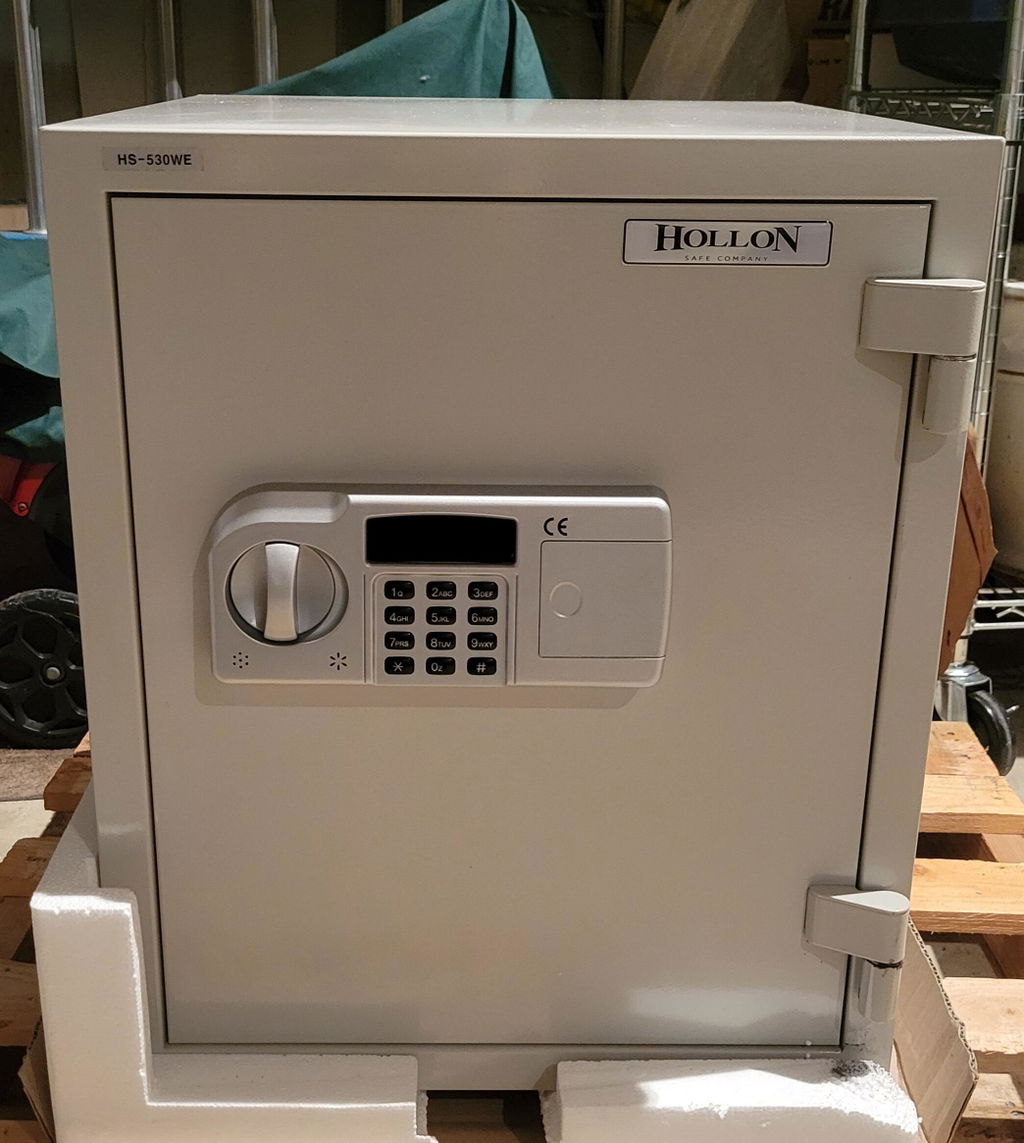
Short answer: the best home safe for most families is a fire and burglary safe such as the Hollon FB-685E ($1,463), which is independently tested for 2 hours at 1,700°F and built with solid steel locking bolts. For documents on a budget, the Hollon HS-500E ($460) gives you 2 hours of fire protection in a compact safe. For jewelry, the AMSEC JS2020E5 combines 12-gauge steel with a fire rating.
The right home safe depends on what you store and what you are protecting it from: fire, theft or both. Every safe below is one we sell; specifications are from the manufacturers and prices are current at time of writing. Browse all of our home safes.
The best home safes at a glance
| Best for | Safe | Protection | Price |
|---|---|---|---|
| Most homes | Hollon FB-685E | 2 hr at 1,700°F, 3 live bolts + locking bar, UL Type 1 lock | $1,463 |
| Documents on a budget | Hollon HS-500E | 2 hr at 1,850°F, compact 0.94 cu ft | $460 |
| Fast access | Barska AX13494 | 30 min at 1,200°F, fingerprint (100 users) | $598.99 |
| Jewelry | AMSEC JS2020E5 | 12-ga steel, 1/4" plate door, ETL fire rated 45 min | $1,282.50 |
| Jewelry and fire | Hollon 685E-JD | 2 hr at 1,700°F, jewelry interior | $1,931 |
| Compact security | AMSEC AM2020E5 | ETL fire certified, 170 lb | $975 |
| Maximum security | Hollon MJ-1014E | UL TL-30 burglary + 2 hr fire | $2,141 |
1. Best home safe for most families: Hollon FB-685E
Most families need protection from both fire and theft. The Hollon FB-685E Oyster Series is independently tested for 2 hours at 1,700°F and uses three solid steel live locking bolts plus a full-length vertical locking bar, with an S&G UL Listed Type 1 electronic lock. At 345 pounds with 2.36 cubic feet inside, it holds documents, cash and jewelry together. A dial version, the FB-685C, is also available.
2. Best for documents on a budget: Hollon HS-500E
If your main concern is fire, the Hollon HS-500E gives you a 2-hour rating tested at up to 1,850°F for $460. It is compact enough for a closet shelf and has an anchor hole for bolting down. For more budget and compact choices, see our small fireproof safes.
3. Best for fast access: Barska AX13494
The Barska AX13494 opens with a fingerprint reader that stores up to 100 users, with a key backup, two long solid steel locking bars and 1.64 cubic feet inside. Its fire rating is a modest 30 minutes at 1,200°F, so it is best for everyday items you reach for often rather than irreplaceable papers.
4. Best for jewelry: AMSEC JS2020E5
The AMSEC JS2020E5 looks like a jewelry cabinet but is built like a safe: a 12-gauge solid steel body, a 1/4-inch solid steel plate door and ETL fire certification for 45 minutes. See all of our jewelry safes, or read our guide to the best jewelry safes for home.
5. Best for jewelry plus long fire protection: Hollon 685E-JD
The Hollon 685E-JD adds a jewelry interior to a fire and burglary safe that keeps the interior below 350°F during a 2-hour test at 1,700°F.
6. Best compact security safe: AMSEC AM2020E5
American Security's AM2020E5 is a compact, ETL fire-certified home safe. At 170 pounds, its weight alone deters a grab-and-go theft, and it bolts down for more.
7. Best maximum-security home safe: Hollon MJ-1014E
For high-value jewelry, coins or cash, the Hollon MJ-1014E is built to UL TL-30 burglary standards and factory tested at up to 1,750°F with the interior held below 350°F. It is the same class of safe used by jewelry stores, sized for a home. Compare more in our TL-rated safes.
How to choose a home safe
Start with what you are storing
Documents need fire protection. Jewelry and cash need burglary protection. Firearms need both; see our fireproof gun safes. Digital backups need a data media safe.
Choose fire, burglary or both
A fire safe insulates; a burglary safe resists tools. A fire and burglary safe does both, and is the right choice for most homes.
Pick a lock you will actually use
Electronic keypads are fast and easy to change. Dials need no batteries. Biometric locks are quickest but should have a backup key or code.
Plan the location and bolt it down
A main-floor interior closet is ideal. Bolt the safe to concrete or framing, and keep it away from garages and flood-prone basements. For hidden storage, consider an in-wall safe.
Frequently asked questions
What is the best home safe?
For most families, a fire and burglary safe such as the Hollon FB-685E, which is tested for 2 hours at 1,700°F and built with solid steel locking bolts, is the best all-around choice.
How much should I spend on a home safe?
About $200 to $500 buys a good fire safe for documents. Expect $1,000 to $2,000 for a fire and burglary safe that protects jewelry and cash as well.
What is the difference between a fire safe and a burglary safe?
A fire safe uses insulation to keep the inside cool during a fire. A burglary safe uses thick steel, bolts and hard plates to resist tools. Many home safes do both.
Should a home safe be bolted down?
Yes. Bolting a safe to the floor is one of the most effective ways to stop a thief from carrying it away.