
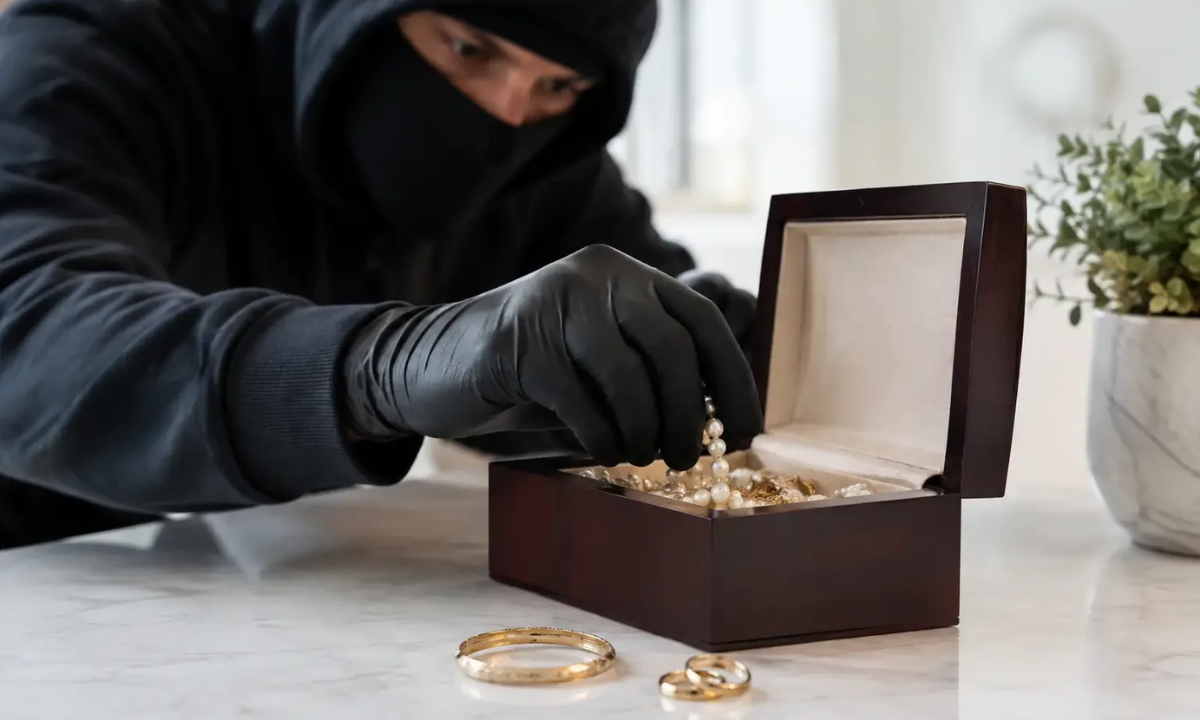
A jewelry theft example does not have to involve a dramatic break-in or a high-profile collection to be costly. More often, it starts with an ordinary assumption: a bedroom drawer, closet shelf, or decorative jewelry box feels private enough. Then a homeowner returns from a weekend away to find the house disturbed, a few electronics missing, and a lifetime of rings, watches, and inherited pieces gone with them.
For jewelry owners, the loss is rarely just financial. Insurance may help replace a gold chain or diamond stud, but it cannot truly replace a grandmother’s wedding band, a military service watch, or a piece chosen for a milestone. That is why jewelry security deserves more thought than a hiding place.
A Realistic Jewelry Theft Example
Consider a composite scenario based on a common pattern. A couple keeps everyday jewelry in a dresser-top box and stores more valuable pieces in a shoebox on a closet shelf. Their home has good exterior lighting and locked doors, but no monitored alarm. Before leaving for a four-day trip, they post a few vacation photos publicly.
Someone enters the house through an unsecured rear window. They do not need to search every room for hours. Bedrooms are efficient targets because jewelry, cash, prescription medications, small electronics, and firearms are often kept there. The intruder checks the obvious locations first: nightstands, dressers, closets, and under the bed. Within minutes, the jewelry box and shoebox are easy to carry away.
The couple had homeowner’s insurance, but the policy’s default jewelry limit is lower than the value of the lost collection. They also had limited receipts and no current photographs of several inherited items. The claim process becomes harder, and even a favorable settlement cannot restore the sentimental pieces.
This jewelry theft example is not meant to create fear. It illustrates a practical point: the places people commonly use for convenience are also the places thieves commonly check. Security works best when it slows access, creates noise or delay, and makes removal difficult.
Why Jewelry Is a Frequent Target
Jewelry has an unfortunate combination of qualities from a security standpoint. It is compact, valuable, easy to conceal, and easy to resell or melt down. A thief can take a substantial amount of value in a pocket, unlike large furniture or major appliances.
That is also why a lightweight lockbox, an unanchored cabinet, or a thin “fire safe” may not be enough for a meaningful collection. Those products can be useful for specific purposes, but they should be evaluated honestly. A portable lockbox may deter casual access or keep items organized. It is not designed to resist being carried out of the home. A fire-rated safe may help protect papers during a fire, yet its burglary resistance can vary widely depending on construction, lock, door design, and anchoring.
The right level of protection depends on what you own, where you live, whether the home is occupied regularly, and how much delay you need the safe to create. There is no single safe specification that fits every jewelry collection.
What Would Have Changed the Outcome?
In the scenario above, a properly chosen and installed safe would not make theft impossible. No security product can promise that. But it could change the burglar’s decision and the amount of time required to reach the valuables.
A jewelry safe should be selected as a system, not as a metal box with a lock. The most useful features begin with solid construction: a substantial steel body, a pry-resistant door, locking bolts, and a reliable lock. For higher-value collections, burglary-rated safes provide a more meaningful benchmark than marketing language alone. A TL-15 or TL-30 rating, for example, indicates a safe has been tested against professional burglary attack for a stated amount of net working time. That is a very different category from an entry-level residential security container.
Anchoring matters just as much. A safe that is not bolted to a suitable concrete floor or structurally sound surface may become a portable object, regardless of how heavy it feels. Installation should follow the manufacturer’s instructions and account for the building structure. In many homes, professional delivery and installation are worthwhile, especially for heavy safes, floor safes, and units placed upstairs.
Placement also matters. The primary bedroom is convenient, but it is often the first room searched. A more discreet location with appropriate structural support can add time and uncertainty for an intruder. Avoid placing a safe where it is immediately visible through a garage, window, or open closet door. At the same time, do not choose a location so inaccessible that you stop using it.
Choosing a Safe for Jewelry, Not Just Storage
A safe built for jewelry should protect the collection and make it practical to inventory and retrieve items. Interior organization is not a luxury when you are storing watches, rings, necklaces, documents, and appraisal records together. Adjustable shelves, lined drawers, ring holders, watch trays, and necklace hooks can prevent tangling and reduce handling damage.
Start by considering the total replacement value, not only the number of pieces. A small collection with one or two high-value watches may require greater burglary protection than a larger collection of lower-value fashion jewelry. If the collection includes heirlooms, the emotional value may justify a higher security level even when an appraisal is modest.
Fire protection is another consideration. Jewelry itself may survive temperatures that destroy boxes, straps, pearls, adhesives, documents, and packaging. Appraisals, photographs, certificates, and insurance paperwork are often just as critical after a loss. A safe with a tested fire rating can help protect those records, but review the stated test conditions and duration rather than assuming every “fireproof” label means the same thing.
Lock choice is a personal decision. Electronic locks offer quick access and can be easy to manage, particularly when a reputable lock is used and batteries are maintained. Mechanical dial locks avoid battery dependence and have a long track record of reliability, though they take longer to open. Biometric access can be convenient for selected applications, but it should not be the only feature driving a safe purchase. Construction, lock quality, installation, and the safe’s overall security rating carry more weight.
Build Layers Around the Safe
A safe is strongest when it is part of a broader home-security plan. Exterior lighting, quality door hardware, locked windows, alarm monitoring, cameras, and trusted neighbors all help reduce opportunity. These measures do different jobs: cameras may provide evidence and deterrence, while a safe provides physical delay and protection once someone is inside.
A few habits can also reduce risk without turning daily life into a security project. Keep a current inventory with photographs, descriptions, serial numbers where applicable, and copies of appraisals. Store digital copies separately from the jewelry itself. Review insurance coverage before a loss occurs, because scheduled personal-property coverage may offer better protection for valuable individual pieces than a standard policy limit.
Be careful about public posts that reveal travel dates, expensive purchases, or the layout of your home. This is not about avoiding social media altogether. It is about recognizing that security information can accumulate over time, especially when a profile is public.
When a Higher-Security Safe Makes Sense
A heavier, burglary-rated safe is usually worth considering when jewelry value is substantial, the home is unoccupied for extended periods, or the collection includes irreplaceable heirlooms. It can also make sense for collectors who want one secure place for jewelry, important documents, cash, and other valuables.
There are trade-offs. Higher-rated safes cost more, weigh significantly more, and may require professional placement. They are not always the right answer for a renter, a small apartment, or a modest collection. In those situations, a compact safe that is securely anchored and discreetly located may be a meaningful improvement over a drawer or closet shelf.
The key is to match the safe to the consequences of loss. A helpful safe specialist should ask about value, available space, floor location, fire concerns, and installation plans before recommending a model. Specifications such as weight, steel thickness, lock type, fire rating, and burglary rating are not just product details - they explain what the safe is designed to withstand.
A jewelry collection deserves more than a convenient hiding place. Take photos, document what you own, review your coverage, and choose protection that makes a quick grab far less likely to become a permanent loss.