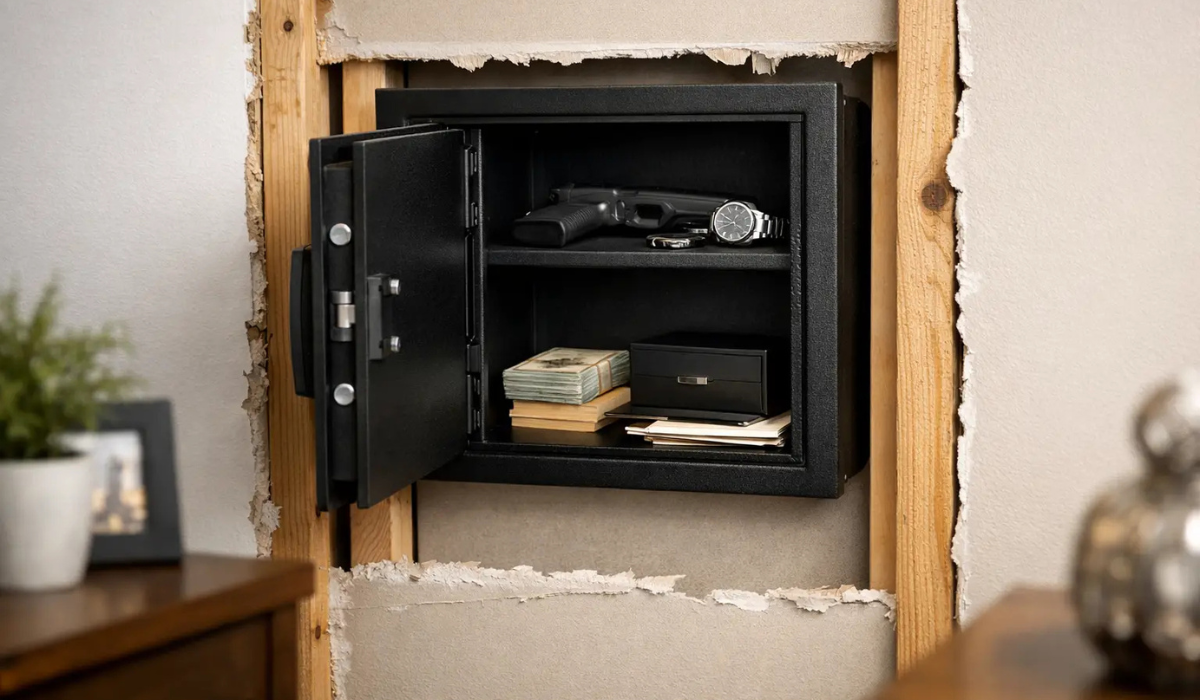
If you are shopping for an in-wall unit, the first measurement that matters is not the door size or even the advertised capacity. It is the in wall safe between studs size - because if the body will not fit the wall cavity cleanly, the rest of the spec sheet does not matter.
Most buyers start with the same assumption: if wall studs are usually 16 inches on center, any in-wall safe should fit. Sometimes that is true. Sometimes it is not. Safe body width, flange dimensions, wall depth, trim clearance, and what is hiding inside the wall all affect whether a model is actually a good fit.
What “between studs” usually means
In most US homes, interior wall studs are commonly spaced 16 inches on center. That does not mean you have a full 16 inches of open space. Because the studs themselves take up room, the actual cavity between two standard 2x4 studs is usually about 14.5 inches wide.
That 14.5-inch number is the one that matters most when evaluating an in-wall safe between studs size. If the safe body is wider than that, it generally will not fit between standard studs without reframing. For many homeowners, reframing defeats the appeal of an in-wall safe, which is supposed to install discreetly with limited wall modification.
There are exceptions. Some homes use 24-inch on-center framing. Some older homes have inconsistent spacing. Some commercial spaces use metal studs. That is why measuring your exact opening is always safer than relying on a rule of thumb.
Standard in-wall safe dimensions to expect
Most in-wall safes designed for residential installation are built specifically for standard stud bays. That usually means the body width lands somewhere around 14 to 14.25 inches, leaving enough room for installation tolerance.
Height varies much more than width. You will commonly see compact models around 20 to 22 inches tall, mid-size options around 25 to 30 inches, and taller configurations that use more of the wall cavity vertically. Depth is usually driven by wall construction. In a standard 2x4 wall, usable depth is often around 3.5 inches before drywall, so many in-wall safes are relatively shallow, often around 3.5 to 4 inches deep in body design.
That creates the main trade-off with this category. In-wall safes are excellent for concealment and convenient access, but they do not offer the same internal volume as a heavier freestanding burglary safe or fire safe.
The right in wall safe between studs size for your wall
The safest way to choose the right in wall safe between studs size is to work backward from the wall cavity, not forward from the items you want to store.
Start with width. Measure the actual gap between the studs, not the outside trim area. In a typical wall, you are looking for roughly 14.5 inches clear. If a manufacturer lists both overall width and body width, focus on the body width first. The flange or trim may sit over the drywall, but the body has to slide into the cavity.
Then confirm height. Height is usually flexible because you can cut drywall vertically within reason, but there may be horizontal fire blocking, wiring runs, plumbing, or cross-bracing in the section you want to use. A tall safe that looks perfect on paper may hit an obstruction halfway down the wall.
Finally, check depth. Standard residential in-wall safes are often made for 2x4 framing, but not every wall is ideal. Exterior walls may include insulation or vapor barriers. Some interior walls are shallower than expected after drywall and finishes are factored in. If the safe body is too deep, it may protrude or require modification you do not want.
Why rough opening and overall dimensions are not the same
One of the most common buying mistakes is looking only at the headline dimensions. Safe manufacturers may list exterior dimensions, door dimensions, cutout requirements, and rough opening recommendations separately. Those numbers are related, but they are not interchangeable.
The rough opening is the wall opening required for installation. The body dimensions describe the portion that goes inside the wall. The trim or frame can extend beyond the body to cover the cut edge of drywall. That trim helps installation look clean, but it can also mislead buyers into thinking a wider unit will fit a narrower cavity.
For this reason, product specs should be read line by line. If you are comparing models, body width, body depth, and rough opening are the priority measurements. Door swing also matters if the safe will sit behind a picture frame, mirror, closet door, or cabinet door.
What you can realistically store in a between-studs safe
An in-wall safe that fits standard studs is usually best for documents, passports, jewelry, cash, compact handguns where legally appropriate, spare keys, watches, and small personal valuables. It is a strong option when concealment is part of the security plan.
It is less ideal for bulky binders, large electronics, thick stacks of paperwork, or high-volume storage. If your priority is fire protection for large document sets, higher burglary resistance, or storage for multiple firearms, a wall safe may not be the right primary solution.
That is where use case matters. A hidden wall safe can work very well as a secondary layer - quick access to critical items, out of casual sight, mounted inside the structure of the home. It is not automatically the best answer for every security need.
Installation factors that change the size decision
Stud type and wall construction
Wood studs are the most straightforward for in-wall installations. Metal studs can complicate mounting and may require different hardware or support planning. Older homes can be less predictable, especially if framing is nonstandard.
Utilities inside the wall
Electrical lines, plumbing, HVAC chases, low-voltage cables, and insulation can all limit your options. A stud finder with live-wire detection helps, but visual inspection after opening the wall is often the real confirmation.
Location in the room
A wall safe behind a painting sounds simple, but furniture placement, shelf depth, and door swing can interfere with access. In closets, door trim and hanging clothes can also reduce usable clearance.
Security expectations
An in-wall safe depends partly on concealment and proper mounting. If your risk profile is higher - repeated cash storage, commercial exposure, or targeted theft concerns - a more substantial burglary-rated safe may be the better investment.
Should you cut studs to fit a larger wall safe?
Usually, no, unless the installation is being handled with proper framing knowledge and the wall is suitable for modification. Cutting a stud to force a larger safe into place can create structural issues, especially in load-bearing walls.
There are installations where reframing is done correctly, but that moves the project beyond a simple between-studs installation. At that point, labor cost, finish repair, and code considerations should be part of the buying decision. For most residential shoppers, choosing a safe designed around standard stud spacing is the cleaner and safer path.
How to compare models without guesswork
When reviewing product specs, compare five numbers before anything else: body width, body height, body depth, rough opening, and door clearance. After that, look at lock type, steel construction, interior layout, and any included mounting hardware.
If fire protection matters, confirm whether the wall safe carries an actual fire rating and understand the limits of that rating. Many in-wall safes are selected for concealment and organization first, not maximum fire resistance. If burglary resistance matters, look for heavier steel construction, reinforced doors, solid locking bolts, and relocking features where available.
This is where a retailer with real product support helps. At Secure Zoned, buyers often compare safe categories by use case, not just dimensions, because the right fit is about both physical size and protection level.
A simple way to choose the right size
If your wall uses standard 16-inch on-center framing, start by looking for in-wall safes with a body width around 14 to 14.25 inches and a depth designed for 2x4 walls. Then check the available vertical space in the wall section you plan to use.
From there, match the internal capacity to what actually needs protection. If you are trying to store a few documents, jewelry, and backup valuables, a compact between-studs model may be ideal. If you keep expanding the list to binders, cash bags, electronics, and multiple firearms, that is a sign you may need a different class of safe.
The best wall safe purchase usually comes from a realistic read on space, structure, and risk. Measure the cavity first, read the cutout specs carefully, and let the wall tell you what size makes sense. Protecting what matters most starts with a fit you do not have to force.