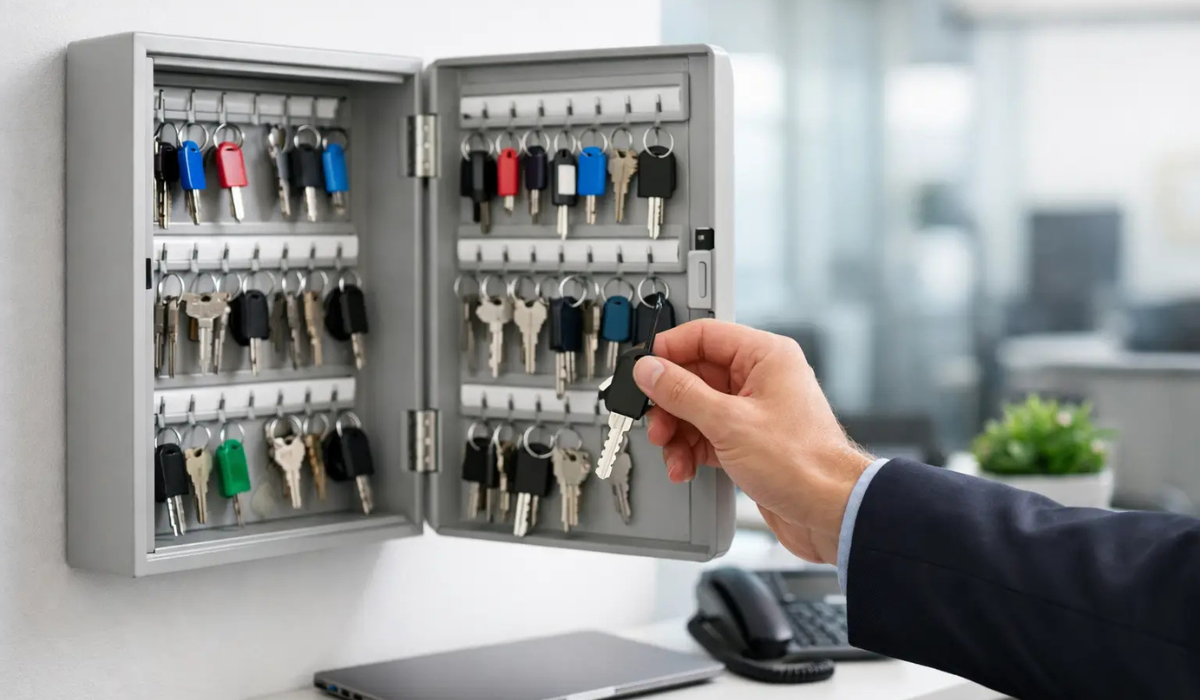
A missing master key can turn an ordinary workday into a security problem fast. If your team still keeps keys in a desk drawer, on a hook behind reception, or in an unlabeled box, a proper key cabinet for office keys is one of the simplest upgrades you can make. It brings control to who has access, where keys are stored, and how quickly your staff can find the right set without guesswork.
Office key storage is not just about neatness. It affects building access, after-hours accountability, vendor entry, and even liability. When keys to file rooms, server closets, supply areas, fleet vehicles, or exterior doors are floating around loosely, small mistakes become expensive ones. A cabinet creates a fixed point of control, which is exactly what most offices are missing.
Why a key cabinet for office keys matters
In a business setting, keys often multiply quietly. What starts as a few front-door keys can expand into copies for managers, cleaning crews, IT staff, maintenance vendors, and temporary workers. Without a dedicated storage system, no one is fully sure which keys exist, who used them last, or whether all copies are accounted for.
That uncertainty creates real risk. Lost keys can require rekeying. Untracked access can expose inventory, records, and restricted areas. Even in lower-risk offices, poor key control wastes time. Staff spend too long hunting for labeled rings, checking the wrong drawer, or texting coworkers to ask who took what.
A well-chosen cabinet solves several problems at once. It centralizes storage, limits unauthorized handling, and makes daily use more efficient. It also supports better policies, because it is much easier to assign checkout rules when keys live in one secured place.
What to look for in a key cabinet
Not every office needs a heavy-duty system, but most need more than a decorative box with hooks. The right cabinet depends on the number of keys, who accesses them, and how sensitive those access points are.
Capacity should fit real-world growth
One of the most common buying mistakes is choosing a cabinet that only fits current keys. Offices almost always add more over time. New doors, duplicated rings, mailbox keys, padlock keys, and spare sets all take up space. If you are counting 30 keys today, a 50-key or even 100-key cabinet may be the more practical choice.
It also helps to think in terms of key sets rather than single keys. A ring with three or four keys plus a tag takes more room and is harder to manage in a cramped cabinet. Extra capacity keeps the layout readable and reduces daily handling errors.
Lock type affects both security and convenience
For many offices, a keyed lock on the cabinet is enough, especially when the cabinet itself is mounted in a controlled interior area. It is simple, familiar, and cost-effective. The trade-off is obvious - you now have to manage access to the cabinet key.
Mechanical combination locks remove the need for a separate cabinet key and work well in environments where a few trusted people need access. Electronic locks can be even more convenient if you need quick code changes after staffing changes. The best choice depends on turnover, shift patterns, and how often access permissions change.
If the cabinet stores keys to high-value areas, sensitive records, cash-handling points, or restricted assets, a stronger lock and tighter access policy make sense. For lower-risk offices, overbuying can add cost without much benefit.
Construction matters more than many buyers expect
A cabinet that holds important building keys should not feel flimsy. Look for solid steel construction, a stable door, secure hinges, and mounting points designed for permanent installation. A lightweight cabinet may organize keys, but it does less to protect them if someone can pry, bend, or remove it easily.
This is where commercial buyers should think beyond appearance. Powder-coated steel, reinforced doors, and tamper-resistant features are more relevant than decorative finishes. If the cabinet is in a back office, utility matters more than style.
Mounting and placement are part of the security plan
A key cabinet is only as secure as its installation. If it is mounted poorly, even a good cabinet becomes an easy target. It should be anchored to a wall surface that can support the unit and resist forced removal. Stud mounting, masonry anchors, or other hardware appropriate to the wall type are worth paying attention to.
Placement also deserves more thought than people usually give it. The cabinet should be accessible to authorized staff, but not obvious to everyone walking through the building. Behind an open reception counter is often too exposed. A manager's office, locked admin room, or controlled operations area usually makes more sense.
Visibility cuts both ways. Hidden placement reduces attention, but if a cabinet is too tucked away, staff may stop using it consistently. The best location is controlled, practical, and easy to monitor.
How to organize a cabinet so it actually works
Buying the cabinet is the easy part. The harder part is setting it up in a way your team will follow.
Use labels that make sense to more than one person
Every hook or slot should match a simple naming system. "Back Door 2" may make sense to one employee and confuse everyone else. Clear labels like "Rear Exit," "IT Closet," "Suite 204 Mailbox," or "Van 1" reduce mistakes. If multiple people use the cabinet across shifts, consistency matters more than shorthand.
Color-coded tags can help in larger offices, especially where departments share the same cabinet. Red for exterior doors, blue for vehicles, green for internal offices, for example, can speed up retrieval and reduce misplacement.
Build a checkout routine
If employees remove keys regularly, a sign-out process is worth having. That does not need to be complicated. For some teams, a paper log is enough. For others, especially those with multiple shifts or outside vendors, a stricter tracking process makes more sense.
What matters is accountability. You should know who took a key, when they took it, and when it came back. If a cabinet holds master keys or sensitive-access keys, this becomes much more important.
Separate high-risk keys from everyday keys
Not all keys deserve the same handling. A spare conference room key is different from a key that opens payroll records, network equipment, or exterior entry points. In some offices, one cabinet can hold both, but high-risk keys should be clearly segregated and limited to a smaller group of users.
In other cases, two separate storage solutions are better - one cabinet for routine operational keys and another more secure unit for restricted-access keys. It depends on the size of the office and the consequences of unauthorized access.
Common sizing mistakes to avoid
Many office managers focus only on hook count. That is useful, but not enough. You also want room for tags, spare rings, and future additions. Crowded cabinets are harder to use and easier to mismanage.
Another issue is underestimating duplicate sets. If your office keeps a primary key, a backup, and a vendor copy, that is three tracked items, not one. Vehicle keys, storage locks, and after-hours access sets can add up faster than expected. A cabinet that looks oversized at purchase often becomes the right size within a year.
Depth and door clearance matter too. If key rings are bulky, tightly spaced hooks can lead to snagging and misplacement. A cabinet should feel organized when full, not only when half used.
Who needs a higher-security setup?
Some offices can treat key storage as a convenience issue. Others need to treat it as part of a broader physical security plan. If your operation handles controlled inventory, medical supplies, sensitive records, regulated materials, or high-value equipment, your cabinet choice should reflect that risk.
The same applies if many non-employees enter the building, such as cleaners, contractors, couriers, and temporary staff. More traffic means more exposure. In these cases, stronger cabinet construction, restricted access, better logging, and tighter placement are not extras. They are reasonable controls.
This is also where a broader product-first security approach helps. A key cabinet does one job well, but it works best when paired with solid door hardware, controlled admin access, and clear internal procedures. Buyers comparing options at Secure Zoned often find that the right answer is not just a bigger cabinet, but a better overall access-control routine.
Choosing the right cabinet for your office
The best key cabinet for office keys is the one your team will actually use every day, without cutting corners. That usually means enough capacity for growth, durable steel construction, a lock type that matches your staffing reality, and secure mounting in the right location.
If your office is small, a compact wall-mounted cabinet with straightforward labeling may be all you need. If you manage multiple departments, shared vehicles, outside vendors, or restricted rooms, step up to a larger cabinet with stronger access control and a real checkout process. Security works best when it fits the way your business already operates.
A good cabinet will not eliminate every key-management problem on its own. What it does is give your office a reliable control point, and that is where better security usually starts.