You can tell when a “quick-access” storage plan was designed by someone who has never tried to reach it half-awake. Nightstands get crowded, drawers stick, and hiding spots turn into scavenger hunts when you need a consistent, repeatable routine.
An under bed gun safe solves a very specific problem: secure storage that stays close to where you sleep without turning your bedroom into a display case. But the details matter. Under-bed models range from slim slide-out safes meant for rapid access to heavier, more security-forward units that behave more like a low-profile burglary safe. Choosing the right one comes down to access style, real security features, and how you plan to mount it.
What an under bed gun safe is really good at
The best use case is controlled access with low visual footprint. Under the bed is typically out of casual sight, and it lets you keep the safe close to your primary “home base” without reorganizing furniture. For many households, it also reduces the temptation to leave a handgun in a drawer because “it’s just for the night.”
There’s also a practical advantage: most under-bed safes give you a wider opening than compact handgun boxes. That can mean space for a full-size pistol, a mounted light, spare magazines, a suppressor-ready host, or even a short carbine depending on interior length.
The trade-off is that under-bed placement is only as strong as your installation. A safe that can slide out can also be dragged out if it is not anchored, and the bed itself can limit what mounting options you can use.
Under bed gun safe vs. nightstand safe
Nightstand safes win on pure reach. If your top priority is grabbing a handgun without leaving the mattress, a small bedside safe can be faster.
Under-bed safes usually win on capacity, discretion, and better room integration. They can also be easier to keep away from kids and guests because they are not sitting at eye level. If you share a bedroom and want to reduce visual clutter, an under-bed safe is often the cleaner solution.
If your routine involves getting to a kneeling position anyway, or you prefer to stage your firearm in a more controlled, two-step process, under-bed access can still be quick - just more deliberate.
The two main styles: slide-out drawer vs. lift-up lid
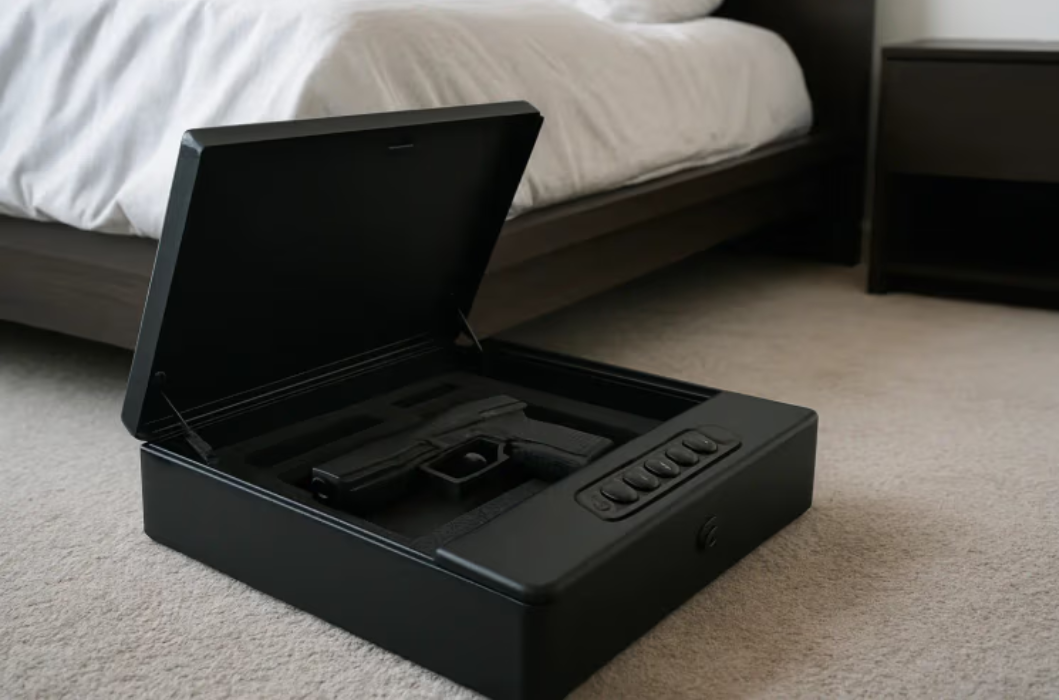
Most buyers picture a slide-out “drawer” safe that you pull toward you. This style is popular because it can be accessed from the side of the bed and it keeps the opening oriented horizontally, which makes it easier to see and grip what you’re doing. Look for smooth travel, a rigid tray, and a design that still opens cleanly when placed on carpet.
Lift-up lid models can work well if you have space at the foot of the bed or if you want the safe positioned to open upward in a specific direction. The drawback is clearance. Some beds, frames, and bedding arrangements make it awkward to open a lid fully.
If you are deciding between the two, measure the clearance you have while accounting for comforters and bed skirts. Real bedrooms are messier than spec sheets.
What “secure” should mean for under-bed placement
Under-bed storage is convenient, but it is not automatically high security. You want a safe that can resist the quick attacks that happen in real homes: prying, yanking, and fast lock tampering.
Start with the body and door construction. Thicker steel and better door fit reduce flex and pry gaps. Many quick-access products focus on speed more than strength, so pay close attention to how the door closes, whether there is a full-length hinge, and how the locking bolts engage. Even without getting into exact gauge numbers, you can usually tell if a unit is designed like a true safe or like a lightweight lockbox.
Anchoring is the next non-negotiable. A safe that is not mounted is portable. Under-bed units should have pre-drilled anchor points and include or support solid mounting hardware. If you are anchoring into a wood subfloor, you want fasteners that bite properly into framing. If you are on concrete, you need masonry anchors. If you are in an apartment where you cannot drill, you will want to rethink placement or choose a heavier safe that can be secured to a bed frame structure - but understand that “secured to furniture” is not the same as “anchored to the building.”
Lock types: biometric, keypad, and mechanical
Your lock choice should match your environment and your habits.
Biometric locks are appealing for speed, but they depend on sensor quality and consistent finger placement. Dry hands, dirty sensors, and certain angles can add friction at the worst time. If you go biometric, look for a model that also offers a backup PIN and a physical key override, and practice opening it from the position you will actually be in.
Electronic keypads are a strong middle ground for most households. A good keypad provides fast access, supports multiple users when needed, and avoids the “will it read me” issue of biometrics. The big risk is battery management. Replace batteries on a schedule, keep spares, and make sure the safe provides clear low-battery warnings.
Mechanical locks can be extremely reliable long term. They are also slower for true quick access, especially in low light. For an under-bed safe intended for defensive readiness, many buyers prefer electronic access with a proven backup method.
Interior fit: it is not just length
Under-bed safes look roomy, but small details decide whether you’ll actually like using it.
Think about how you store the firearm. If you run a weapon light, confirm the internal height and whether the safe’s foam or brackets can be configured around it. If you want to store a handgun and spare magazines in a consistent orientation, check whether the interior includes adjustable dividers, a tray, or at least foam you can customize.
Also consider how you want the door to present the contents. A drawer that opens fully lets you index your grip more naturally. A partial extension can force you to reach deeper under the bed and can increase muzzle sweep risk as you maneuver. This is a quality-of-life issue that affects safety.
Sizing and bedroom realities: measure like an installer
Under-bed safe dimensions on a product page are only the beginning. Your bed frame may have cross supports, drawers, or a center rail. You might have carpet pile that steals clearance. You might have a platform bed with a lip that blocks the safe from sliding out.
Measure the usable footprint under the bed, then measure the access path. You need to know you can physically get the safe in and out during installation without forcing it at an angle that damages the lock or rails. If your plan is to mount it, confirm you can still reach the anchor holes with a drill and a driver.
If you are between sizes, err toward the model that gives you better hand clearance during opening, not just more storage volume.
Installation: the part that decides whether it works
A well-chosen under bed gun safe can be undermined by a rushed install.
First, pick the access side and commit to it. Opening from the same side every time builds muscle memory, which matters for both speed and safety. Second, confirm that the safe can open without binding on carpet or snagging on bed skirts. Third, anchor it in a way that matches your home construction. If you are not sure what you are drilling into, slow down and verify - many floors have plumbing and wiring paths you do not want to discover the hard way.
If you want extra stability, consider pairing the safe with a bed frame that has a rigid, accessible underside. Some setups allow you to mount through the frame into the floor for improved resistance to leverage attacks.
Responsible access in a shared home
Under-bed placement is often chosen in family homes because it reduces visibility. That’s helpful, but the real goal is controlled access.
If kids are in the house, prioritize a lock style that does not rely on a key left “somewhere safe.” Keys migrate. A fast electronic lock with a practiced code routine is usually easier to keep disciplined.
If multiple adults need access, look for models that support multiple codes or reliable biometric enrollment for more than one user. Make sure you can quickly disable access if a code is shared too widely.
And if you have frequent guests, treat under-bed storage like any other defensive readiness plan: keep it consistent, keep it locked, and don’t discuss it casually.
When an under-bed safe is the wrong answer
It depends on your threat model and your room layout.
If your primary concern is burglary resistance while you’re away, an under-bed unit may not be the best “main safe.” A heavier, full-size gun safe or a burglary-rated safe with more substantial construction and anchoring options is a better fit for long-duration protection.
If mobility is required, such as travel between properties, under-bed units can be awkward. A compact handgun safe designed for transport and temporary mounting may make more sense.
If you cannot anchor and you’re choosing a lightweight model, you should assume it could be removed quickly. In that case, you may be better served by a different location with stronger mounting options or a heavier safe that changes the math for a grab-and-go theft.
Buying guidance that stays practical
When you shop, it helps to compare products the way you’ll use them: how fast the door opens, whether the tray extends fully, whether you can mount it properly, and whether the lock gives you confidence at 2 a.m.
If you want a wide selection across lock types and security tiers, browse under bed gun safes at Secure Zoned. Their call or text support can help you sanity-check sizing and installation before you buy.
The best under-bed gun safe is the one you will actually keep locked, actually practice opening, and actually mount the right way - because consistency is what turns “close by” into “controlled and ready.”