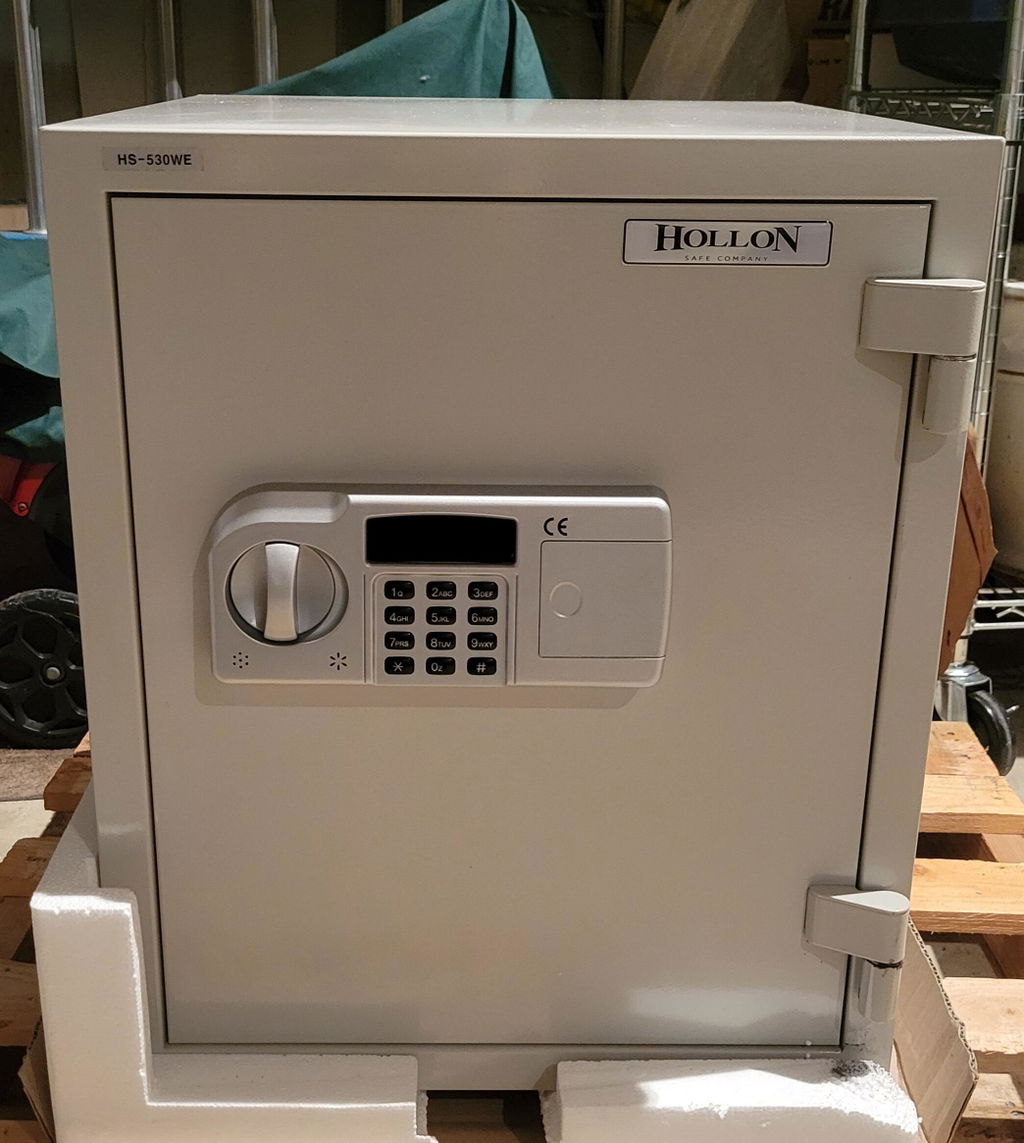
Short answer: most businesses that handle cash daily need a depository (drop) safe, so staff can make deposits without being able to open the safe. A B-rated front-load or rotary-hopper depository safe covers most stores and restaurants. If you keep larger amounts overnight, step up to a UL-listed TL-15 or TL-30 safe, which is also what many insurers look for. Below are real models we sell for each need.
Business cash safes compared
| Safe | Type | Key security features | Price |
|---|---|---|---|
| Hollon DP-25EL | Under-counter drop safe | Envelope drop slot, electronic lock with key override, 17 lbs, 0.74 cu ft | $127 |
| Mesa MFL2714E | Front-load depository, B-rated | 1/2″ steel door, five 1″ bolts, anti-fish baffle, 1–59 minute time delay, 1.4 cu ft | $569 |
| Hollon RH-2014E | Rotary hopper depository, B-rated | One-way rotary hopper, 1/2″ steel door, UL-listed Type 1 electronic lock | $668 |
| Hayman CV-F30W-ILK C | Front-load with inner locker, B-rated | Deposits land in a separately keyed inner locker (dual control), 16 1/8″ loader fits bank bags, 223 lbs | $1,225 |
| Hollon FDD-3020EE | Double-door depository | Separate deposit and storage compartments, two UL-listed Type 1 electronic locks, 1.25″ bolts | $1,358 |
| Hollon PM-1014E | High-security, UL TL-15 | UL-listed TL-15 burglary rating plus 2-hour fire rating | $1,720 |
| Hollon MJ-1014E | High-security, UL TL-30 | UL-listed TL-30 burglary rating plus 2-hour fire rating, 0.87 cu ft | $2,141 |
Prices are current at the time of writing and may change. Browse all drop and depository safes or TL-rated safes.
Step 1: match the safe to how much cash you hold
- Daily register cash and change: a B-rated depository safe. B-rate describes the steel construction (typically a 1/2″ steel door and 1/4″ steel body); it is a construction standard, not a lab attack test.
- Larger overnight balances, high-value inventory: a UL-listed TL-15 or TL-30 safe. These are tested by UL to resist an expert attack with tools for 15 or 30 minutes of working time.
- Check with your insurer. Insurers set how much cash they will cover based on the safe’s rating. Ask what rating they require for the amount you keep before you buy.
Step 2: choose the right type
Under-counter drop safes
Small, low-cost safes with a drop slot that mount under a counter for skimming cash during a shift. Good for limiting what is in the register; not designed for large overnight balances.
Front-load depository safes
A mailbox-style deposit door on the front, with an anti-fish baffle so deposits cannot be pulled back out. The most common choice for retail and restaurants. Browse front-loading deposit safes.
Rotary hopper safes
Deposits go into a rotating drum that drops them into the safe with a turn of the handle. Very resistant to fishing and simple for staff to use. Browse rotary hopper safes.
Inner-locker and double-door safes
Deposits land in a separately locked compartment. A shift manager can open the main safe for change and drawers without access to the day’s deposits, which keeps accountability clear between shifts and cash pickups.
TL-rated high-security safes
For larger sums, jewelry, or inventory. Many TL safes also carry a fire rating; most depository safes do not.
Features that matter for cash handling
- Time-delay lock: the lock waits a set number of minutes before opening, which discourages robbery. The Mesa MFL2714E allows 1–59 minutes.
- Multiple user codes and audit trails: separate codes for managers and staff, and on audit locks, a record of who opened the safe and when.
- Anti-fish baffle or rotary hopper: stops deposits from being pulled back out of the slot.
- UL-listed lock, hardplate and relocker: protect against drilling and lock attacks.
- Anchoring: bolt the safe to a concrete floor through the pre-drilled holes so it cannot be carried out.
How to keep cash in a business safe
- Make regular drops during the shift so the register never holds more than needed.
- Give staff deposit access only; limit combinations to managers.
- Use bank bags or envelopes labeled with shift and amount for every drop.
- Count and reconcile with two people present where possible.
- Make bank deposits on a varied schedule and keep overnight balances within your insurance limit.
Frequently asked questions
What is the best safe for a small business?
For most small retail and food businesses, a B-rated front-load or rotary-hopper depository safe with an electronic lock, such as the Mesa MFL2714E or Hollon RH-2014E. Step up to a TL-rated safe if you hold large amounts overnight.
What is the difference between a drop safe and a depository safe?
The terms are often used interchangeably. Both let staff deposit cash without opening the safe. “Drop safe” often refers to smaller under-counter units; “depository safe” usually means a larger safe with a front-load door or rotary hopper.
Do business cash safes need a fire rating?
Not necessarily. Many depository safes, including the Hayman CashVault models, are burglary rated only. If you also store records or need fire protection, choose a safe with a fire rating, such as the TL-15 and TL-30 models above, which carry 2-hour ratings.
Should a business safe be bolted down?
Yes. Even a 200 lb safe can be removed with a hand truck. Bolt it to a concrete floor using the anchor holes.