
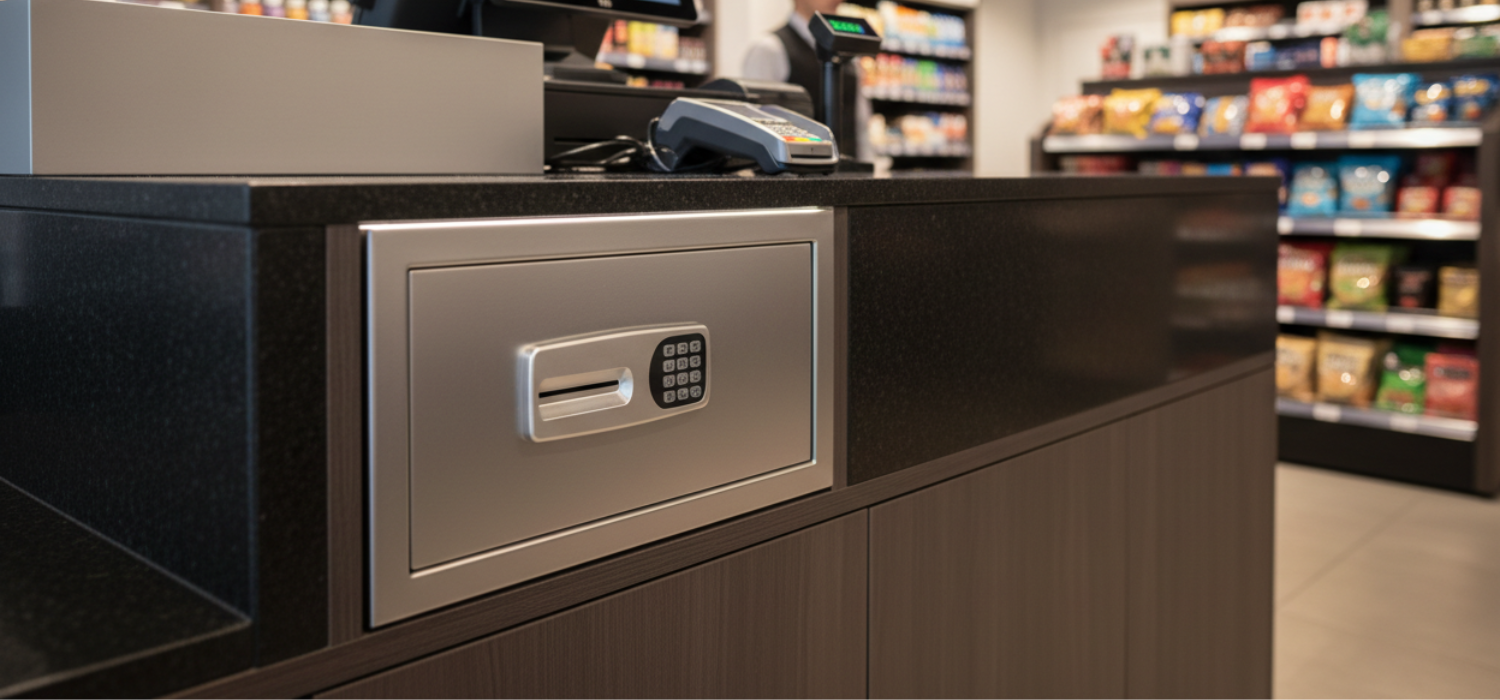
The moment your register starts stacking 20s during a rush, you have a decision to make: let cash sit where everyone can see it, or move it out of reach fast. Convenience stores run on speed, late hours, and a constant flow of small transactions - which also makes them a frequent target for grab-and-go theft and armed robbery. A cash drop safe is one of the simplest ways to change that math. Not because it makes your store “invincible,” but because it reduces opportunity and limits how much money is exposed at any one time.
What a cash drop safe actually does
A cash drop safe is built for deposits, not access. Staff feed bills (and sometimes drops in envelopes or deposit bags) through a slot or drop drawer. Once the cash falls into the body of the safe, the person at the counter should not be able to reach it again.
That one-way workflow is the point. If a thief forces an employee to open the register, the register is all they get. When drops are happening consistently, the loss ceiling is dramatically lower.
Most convenience stores also like drop safes because they keep cash handling more disciplined. A set drop policy (say, every $200 in the till) reduces end-of-shift counting mistakes and helps you reconcile deposits more cleanly. The safe becomes a routine, not a special event.
Cash drop safe for convenience store: where it belongs and why
Placement matters as much as the safe itself. A drop safe only reduces risk if employees can use it quickly without leaving the counter unprotected.
In many stores, the best location is under the counter near the primary register, mounted so the drop slot is reachable while still facing customers. That allows drops during busy periods without creating a tell - like an employee stepping away, fumbling with keys, or opening a back-office door.
There are trade-offs. Under-counter placement can be tight, and if the safe is too small or awkward to access, staff will “forget” to use it when the line is long. Back-office placement keeps it farther from the public area, but it increases the chance that drops stop happening when the store is busy. For high-traffic locations, convenience usually wins.
The features that matter (and the ones that don’t)
Drop safes look similar in photos, but the security difference can be significant. You do not need every upgrade for every store, but you do need the basics done right.
Steel, door construction, and the real-world threat
For a convenience store, the most common threat is a fast forced entry attempt - prying, punching, or aggressive attacks on the lock area. You want a safe that uses solid steel construction, a strong door, and meaningful internal locking mechanisms.
If your store keeps larger amounts on-site (common in rural areas, high-cash neighborhoods, or stores that do a lot of money orders), it can be worth moving up to higher-security burglary-rated models. TL-rated safes (such as TL-15 or TL-30) are designed for serious tool attacks and offer a different level of protection, but they cost more and are heavier. It depends on your overnight cash exposure and how long police response typically takes in your area.
A true anti-fish deposit design
One of the most overlooked details is the deposit method. A simple slot is not automatically secure. You want an anti-fish baffle or chute that prevents someone from pulling bills back out with a wire, tape, or improvised tool.
If you plan to drop bundles, envelopes, or deposit bags, pay attention to deposit size. A safe can be “secure” but still be a poor fit if deposits jam or require folding. Jams create workarounds, and workarounds defeat the entire system.
Lock type: electronic vs mechanical
Most stores choose an electronic lock because it supports fast access for managers and reduces key control headaches. A quality electronic lock also makes it easier to rotate codes when staffing changes.
Mechanical dial locks are proven and reliable, but they are slower and require more training. They can make sense for the inner compartment or for locations that want fewer electronics in hot, humid, or dusty environments.
Regardless of lock type, prioritize recognized standards and quality components. A lock is not just a keypad - it is the part thieves attack first.
Time delay and dual control (when it helps)
Time delay is one of the strongest deterrents for robbery scenarios because it makes “open it now” impossible. The trade-off is operational friction. If your safe is also used for change funds or emergency access, time delay can frustrate staff and create unsafe behavior (like leaving the safe open during a shift).
Some stores solve this by using a two-stage approach: a drop safe for deposits, and a separate small under-counter safe for limited change, or a locked cash drawer system with strict limits.
Dual control (two codes or two keys) can improve accountability, especially for multi-manager environments, but it can also slow down deposit processing. It fits best when shrink is a bigger problem than speed.
Don’t skip installation - anchoring is the difference maker
A drop safe that is not anchored is a portable object. Even a heavy safe can be moved with two people and a hand truck if the store is closed and no one is watching.
For most convenience store installs, you want the safe bolted into concrete or structurally secure framing, using the manufacturer’s anchor points. Under-counter safes should be anchored to the floor whenever possible, not just to cabinetry.
Also think about visibility. A safe placed where it can be quietly attacked after hours is a higher risk than one located where cameras capture the approach and the work area clearly.
If you lease your space, anchoring is still usually possible, but you may need landlord approval and a plan for patching. That small step is worth it - the safe is only as strong as what it is attached to.
Capacity and workflow: make it easy to do the right thing
If your safe fills too quickly, employees will stop using it or start stacking drops nearby “until later.” Both outcomes increase risk.
Right-sizing depends on your cash volume and how often you pull deposits. A 24-hour store with strong cash sales may need more capacity than a smaller location that runs mostly card transactions. If you do frequent drops and regular pulls, a smaller safe can work. If you do fewer pulls, invest in capacity.
Pay attention to whether the safe includes an inner compartment (a separate locked area inside). That can be useful for separating deposits by shift, storing bank bags, or keeping higher-value drops distinct.
Building a drop policy that employees will follow
A safe helps most when the process is simple and consistent. Aim for a policy that can be explained in one minute and followed on a stressful shift.
For example: drops happen at a set till threshold, drops happen on a schedule (hourly), or drops happen after specific events (after a large cash transaction). Pair the policy with accountability - shift leads verify drops, and managers reconcile against POS reports.
Training matters too. Employees should know how to make a drop without turning their back to the store, without counting cash in the open, and without announcing what they are doing. Quiet routine is safer than dramatic “security steps.”
When you should consider stepping up to higher-security safes
Not every convenience store needs a high-end burglary safe, but some do.
If your store is in an area with repeat smash-and-grab incidents, if you have long periods with a single employee, or if you routinely hold significant cash overnight, consider upgrading beyond basic construction. This is where heavier bodies, stronger boltwork, relockers, and higher burglary ratings start to matter.
Also think about what else ends up in the safe. Many stores use their deposit safe to store lottery settlement paperwork, tobacco inventory keys, or sensitive documents. If your safe is protecting more than cash, fire resistance and higher burglary protection may be worth the added cost and weight.
Choosing the right model without overbuying
A cash drop safe for convenience store operations should match your risk profile, not your anxiety level. The “best” safe is the one your staff will actually use, that is anchored correctly, and that meaningfully reduces exposure.
If you are comparing models and getting stuck between options, focus on three questions: how the deposit is protected (anti-fish and deposit size), how the safe resists attack (steel and construction quality), and how access is controlled (lock quality, code management, time delay if appropriate).
If you want help narrowing down a deposit safe based on your store’s layout, cash volume, and security goals, Secure Zoned can walk you through options and specs with real buying guidance at https://securezoned.com.
A well-chosen drop safe does not change what your store sells or how fast your line moves. It quietly changes what a bad night can cost you - and that is the kind of improvement you feel most when you never have to find out the hard way.