A cash drawer is most vulnerable during the moments between a sale and a bank deposit. A depository safe with rotary hopper gives employees a controlled way to drop bills, checks, and envelopes without giving them access to the safe’s protected storage area. For restaurants closing late, retailers handling busy shifts, and offices receiving payments, that separation can make daily cash handling considerably safer.
This is not a safe that simply stores money overnight. It is a tool for reducing exposure throughout the workday. Choosing one well means looking beyond exterior dimensions and asking practical questions about deposits, access, placement, anchoring, and the level of burglary protection your business actually needs.
How a Rotary Hopper Depository Safe Works
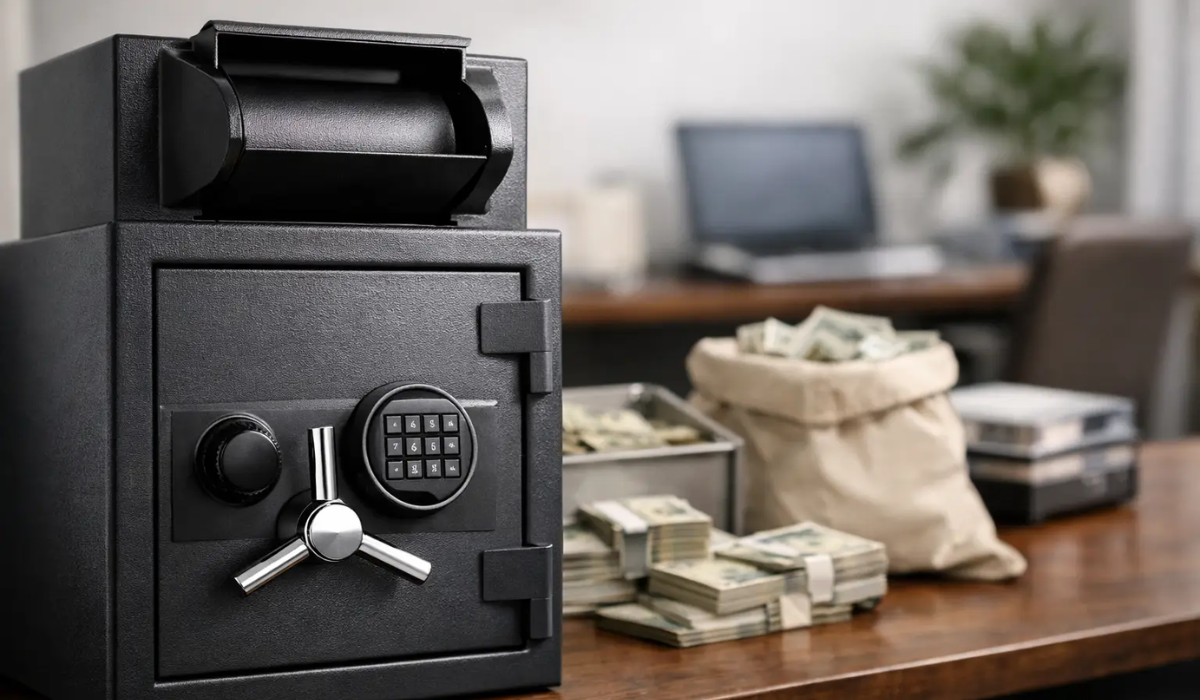
A rotary hopper is a rotating deposit compartment built into the safe door or top of the safe. An employee places cash or an envelope into the hopper, turns the handle or drum, and allows the contents to fall into the secure interior. Once the hopper returns to its resting position, the person making the deposit cannot reach into the safe body.
That is the key advantage. Employees can make routine deposits, while a manager, owner, or armored cash service retains access to the main compartment through a separate lock. In a well-run operation, this reduces the amount of cash left in registers and limits the number of people with access to accumulated funds.
Rotary hoppers are often confused with deposit slots. Both allow deposits without opening the safe, but they serve different needs. A narrow slot works well for checks, receipts, and folded currency. A hopper is usually more forgiving for cash bundles, deposit bags, and thicker envelopes. It also helps prevent someone from fishing items back out through the opening, although the exact protection depends on the hopper design.
When a Depository Safe With Rotary Hopper Is the Right Choice
A rotary hopper safe makes the most sense when deposits happen regularly and more than one employee is involved in handling money. Quick-service restaurants, bars, convenience stores, auto shops, retail counters, cannabis-adjacent businesses operating within their local rules, and hospitality desks are common examples.
It can also be a smart choice for an office that accepts payments in person. A receptionist can secure checks and envelopes as they arrive instead of keeping them in a desk drawer until the end of the day. For a business owner, the benefit is not just theft prevention. It creates a more consistent cash-handling process.
Still, a hopper is not automatically the best answer for every business. If you receive only occasional checks, a compact front-loading deposit slot may be enough. If staff need to deposit large stacks of bills or sealed bank bags, verify the hopper opening and interior clearance before buying. A hopper that is too small leads employees to delay deposits, which defeats the purpose.
What to Look for Before You Buy
The right safe begins with the deposit itself. Measure the largest envelope, bag, or cash bundle you expect employees to use, then compare it with the manufacturer’s stated hopper dimensions. Exterior size alone does not tell you whether your typical deposit will fit comfortably.
Hopper size and anti-fishing design
Look for a hopper with a practical opening and an internal design that prevents reach-back attempts. Rotary hoppers naturally create more of a barrier than a basic slot, but construction varies between models. For higher-risk cash environments, choose a safe from an established commercial manufacturer and review the design details rather than relying on a product photo alone.
Think about how deposits will be made under pressure. At a busy counter, staff should be able to use the hopper quickly without forcing envelopes, wrestling with a tight handle, or exposing cash in front of customers.
Steel construction and door design
Commercial depository safes are available in different steel thicknesses and security levels. Heavier steel, reinforced doors, solid locking bolts, and hardplate protection around the lock all contribute to resistance against forced entry. These features matter most when the safe will hold significant cash for long periods or sit in an area with limited oversight.
A basic depository safe may be appropriate for low to moderate cash volume in a monitored business. A location with higher daily receipts, greater burglary exposure, or overnight cash storage may justify stepping up to a more heavily built burglary-rated safe. A safe’s weight can be a useful clue, but it is not a substitute for reviewing its construction and independent ratings.
Lock type and access control
The safe’s main door lock determines who can remove deposits. Electronic keypad locks are popular because they allow quick access and, on some models, user-code management or audit features. Mechanical combination locks avoid batteries and can be a good fit for businesses that prefer a simple, time-tested system.
For locations with several managers, ask whether the lock supports multiple codes and whether codes can be changed when staffing changes. A key lock may be suitable for a low-risk application, but keys can be copied, lost, or passed between employees without a record. For most cash-handling businesses, a quality commercial-grade electronic or mechanical lock offers better control.
Internal space and compartment layout
The deposit hopper is only half the equation. Check the usable interior capacity after accounting for the hopper mechanism, shelves, lockers, or deposit compartments. A safe that looks spacious from the outside may fill quickly with deposit bags.
Some businesses benefit from a dual-compartment configuration. One section can hold employee deposits, while another is reserved for change funds, manager access, or separate departments. This setup supports clearer accountability, but it also adds complexity. If your process is simple, one secure compartment with disciplined access rules may be the better fit.
Anchoring and placement
A depository safe should be anchored to a solid concrete floor whenever the manufacturer provides mounting holes and the installation site allows it. Anchoring is especially important for smaller units that could otherwise be carried away. Use appropriate hardware and follow the manufacturer’s instructions, or have a qualified installer handle the job.
Placement should balance security and workflow. A back office, manager area, or secured counter enclosure is usually better than an exposed public area. At the same time, staff need to reach the safe easily enough to make deposits consistently. If it is too inconvenient to use, cash will end up in registers, drawers, or improvised hiding places.
Fire Protection and Burglary Protection Are Different
Business buyers sometimes assume a heavy depository safe protects equally well from fire and theft. These are separate performance goals. A burglary-focused safe is built to resist prying, drilling, and other attack methods. A fire-rated safe is designed to maintain a lower internal temperature for a specified period during a fire.
If your main concern is cash control and theft deterrence, prioritize construction, lock protection, boltwork, and anchoring. If the safe will also hold critical paper records, contracts, or backup documents, consider a model with a stated fire rating that matches your risk and retention needs. Paper documents and digital media have different temperature tolerances, so do not assume one fire rating protects everything.
For businesses with substantial overnight cash exposure, a standard depository safe may not provide the level of burglary resistance required by an insurer. Ask your insurance agent whether a specific safe rating, alarm system, or cash limit applies to your policy. A TL-rated safe may be appropriate in higher-risk situations, but it comes with greater cost, weight, and installation requirements.
Build the Safe Into Your Cash-Handling Procedure
A good safe cannot fix a loose process. Decide who can deposit money, who can open the main compartment, when counts occur, and how discrepancies are documented. Keep the number of people with retrieval access as limited as practical.
A simple routine often works best: employees make drops at set drawer thresholds or scheduled intervals, deposits are recorded by register or employee, and only authorized managers retrieve funds. If deposits include checks or paperwork, use labeled envelopes or tamper-evident bags so the contents remain attributable after they enter the safe.
Avoid sharing manager codes broadly. Change electronic lock codes when a manager leaves, after a suspected compromise, and on a regular schedule that fits your operation. Battery checks should also be part of routine maintenance. An electronic lock with a low battery warning is helpful, but replacing batteries proactively is less disruptive than dealing with a lock issue during a closing shift.
Choosing With Confidence
The best depository safe with rotary hopper is the one that fits your real deposit volume, limits access without slowing down staff, and is built for the security risk at your location. Start with the hopper opening and usable capacity, then compare construction, lock options, anchoring provisions, and any fire or burglary ratings that matter to your business.
Cash should not have to wait until closing time to be protected. A properly sized, securely anchored hopper safe gives your team a clear place to put every deposit and gives you greater control over what matters most.