A pickup can be part of your everyday routine: a work vehicle, a hunting rig, or the truck you rely on during a long drive. That convenience makes secure firearm storage a serious consideration. The right gun safe for pickup trucks keeps a firearm out of unauthorized hands, reduces the chance of a quick grab-and-go theft, and gives you a more controlled way to transport it when vehicle storage is permitted.
A truck safe is not a reason to leave a firearm in a vehicle longer than necessary. Vehicles are common targets for theft, and even a well-built safe has less protection than a properly installed safe at home. Still, when you need secure, temporary storage, choosing the right design and installing it correctly makes a meaningful difference.
Start With Where the Safe Will Go
The best location is usually the one that balances concealment, usable space, solid mounting points, and safe access. In a pickup, that often means an under-seat safe, a center-console vault, or a behind-the-seat lockbox. The right answer depends on the truck's cab configuration and how you use it.
Under-seat safes are popular in crew-cab and extended-cab pickups because they use otherwise wasted space and stay out of sight. They can work well for handguns and, in some configurations, other compact items. Before buying, measure the clear space beneath the seat with the seat fully adjusted. Account for seat brackets, wiring, vents, floor mats, and the safe door's swing or slide path.
A center-console vault can be a discreet choice when your truck has a deep console. It is convenient for a compact handgun, but space is limited, and the vault needs to fit the console's interior dimensions closely. A safe that rattles, interferes with the console lid, or blocks the factory latch is not a good fit.
Behind-the-seat safes and cab-mounted lockboxes can provide more room, especially in regular-cab trucks. They may be appropriate for a handgun, ammunition, and related gear, but they should not turn the cab into an obvious storage area. If the safe is visible through a window, it invites attention.
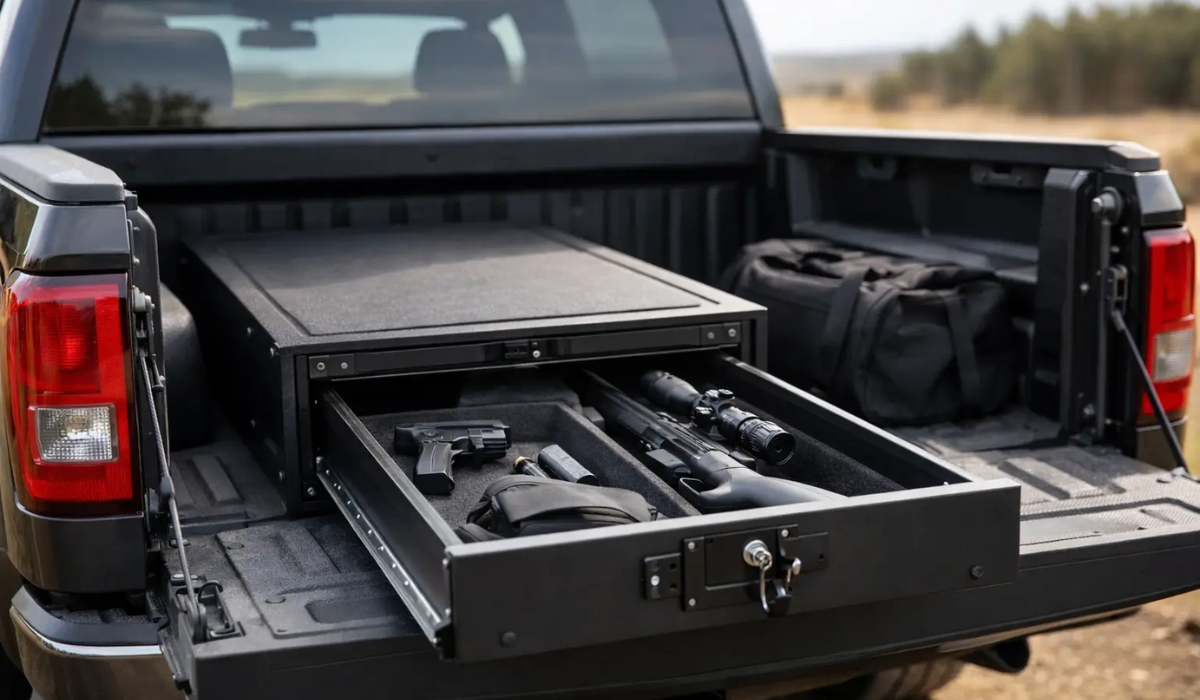
Truck-bed boxes have their place for tools and equipment, but they are typically a poor choice for everyday firearm access. They are exposed to wider temperature swings, moisture, dust, and public visibility. If a bed-mounted option is your only practical choice, choose a weather-conscious design and treat it as transport storage rather than quick access.
What a Gun Safe for Pickup Trucks Should Protect Against
Vehicle safes face a different threat profile than a full-size home gun safe. Most vehicle break-ins are fast. A thief may have only minutes to look through a console, reach under a seat, or remove an unsecured box. Your goal is to make the firearm difficult to find, difficult to remove, and difficult to open.
Construction matters. Look for a steel body and a door that does not flex easily. Heavier-gauge steel generally offers better resistance to prying, although steel thickness is only one part of the design. Door seams, hinge protection, locking bolts or locking tabs, and the strength of the mounting hardware all affect real-world security.
The safe must also be anchored to the vehicle. A steel box secured only with a cable can slow down a thief, but it can often be carried away with enough time and the right tool. Whenever the truck and safe design allow it, use factory mounting points, seat bolts, or reinforced vehicle structure with the manufacturer's approved hardware. Avoid drilling blindly into the floor. Modern pickups may have fuel lines, wiring harnesses, sensors, and components beneath the cab.
A simple rule applies: the safe should be harder to remove than the firearm is to steal. If you can lift the entire safe out by hand, its security is limited.
Match the Lock to Your Routine
There is no single best lock for every truck owner. The right choice depends on how quickly you need access, who may be around the vehicle, and whether the safe will be exposed to heat, cold, vibration, or low battery power.
Mechanical Simplex-style push-button locks are valued for their reliability. They do not require batteries, can be opened by touch with practice, and avoid concerns about electronic failure. Their trade-off is that they may offer fewer code combinations and require deliberate operation.
Electronic keypad locks are familiar and convenient, particularly when multiple authorized adults need access. Choose a model with a low-battery warning and an emergency override method that you can manage responsibly. Do not leave an override key in the glove box, console, or anywhere else inside the truck.
Biometric locks can provide fast access, but quality varies. A reliable biometric safe should recognize enrolled fingerprints consistently under normal conditions. Before relying on one in a vehicle, enroll more than one finger, test it repeatedly, and make sure you understand the backup entry method. Dirt, moisture, cuts, and extreme temperatures can affect fingerprint performance.
For temporary vehicle storage, speed should never outweigh secure retention. If children, passengers, employees, or untrained adults may be in or near the truck, prioritize a safe that remains locked, mounted, and inaccessible to them at all times.
Measure the Firearm, Not Just the Product Description
Interior dimensions are more useful than an exterior label such as “large” or “fits most handguns.” Measure the firearm in its actual stored condition. A red-dot optic, weapon-mounted light, extended magazine, holster, or suppressor-height sights can change what will fit.
Check height, length, and thickness, then allow room for the door mechanism and interior padding. A handgun that barely fits can press against the lid, shift during driving, or fail to sit correctly for quick retrieval. If you plan to store a spare magazine, make sure it has a dedicated place rather than resting loose beside the firearm.
Long-gun storage requires even more care. Most pickup safes are designed for handguns, not rifles or shotguns. A long gun should be transported according to applicable laws and secured in a purpose-built, locked solution that fits the vehicle and prevents unauthorized access. Do not assume a soft case, a rear-window rack, or a tool box provides adequate security.
Consider the Truck Environment
A vehicle cab can become extremely hot in summer and very cold in winter. Temperature swings can shorten battery life, affect electronic locks, and contribute to condensation. In dusty work trucks or off-road vehicles, dirt and vibration add another layer of wear.
Choose a safe with a finish that resists corrosion and an interior that protects the firearm from scratches. Periodically inspect the firearm and safe for moisture, surface rust, loose mounting bolts, damaged padding, and debris around the lock or door. A small desiccant pack may help in humid conditions, but it does not replace routine inspection and proper firearm maintenance.
Fire ratings, while valuable for home safes and document protection, are rarely the deciding feature for a pickup truck safe. Focus first on secure mounting, steel construction, lock reliability, and a fit that allows the safe to remain concealed.
Installation Is Part of the Security Rating
Even a quality vehicle safe can underperform if it is installed poorly. Follow the safe manufacturer's instructions and your truck manufacturer's guidance. If installation requires modification near structural components, electrical systems, or airbags, have a qualified installer handle the work.
After installation, test the safe with the truck parked. Open and close it from the driver's and passenger's positions if relevant. Move the seats through their full range. Confirm that passengers cannot accidentally kick the safe, that the door clears surrounding trim, and that the unit does not rattle or shift on rough roads.
Also think about visibility after installation. A safe that blends into the cabin is usually preferable to one that looks like an expensive accessory. Keep the truck locked, avoid leaving firearm-related items in plain sight, and do not advertise what may be stored inside.
Know the Rules Before You Store or Travel
Firearm transportation and vehicle-storage rules vary by state, city, property, and destination. Rules may address whether a firearm must be unloaded, how it must be secured, where it may be stored, and whether it may be present on certain properties. Interstate travel can add further requirements.
Review the laws that apply to your route and destination before relying on a truck safe. Employer policies, school-zone restrictions, private-property rules, and parking-area regulations may be stricter than the rules you follow at home. A secure safe supports responsible storage, but it does not override legal restrictions.
A well-chosen truck safe should fit your firearm, your vehicle, and your actual routine without creating false confidence. When you need help comparing construction, lock styles, or mounting considerations, Secure Zoned can help you narrow the options to a safe built for the way you use your pickup. The safest habit remains simple: store the firearm in the vehicle only when necessary, secure it properly when you do, and bring it inside as soon as you reasonably can.