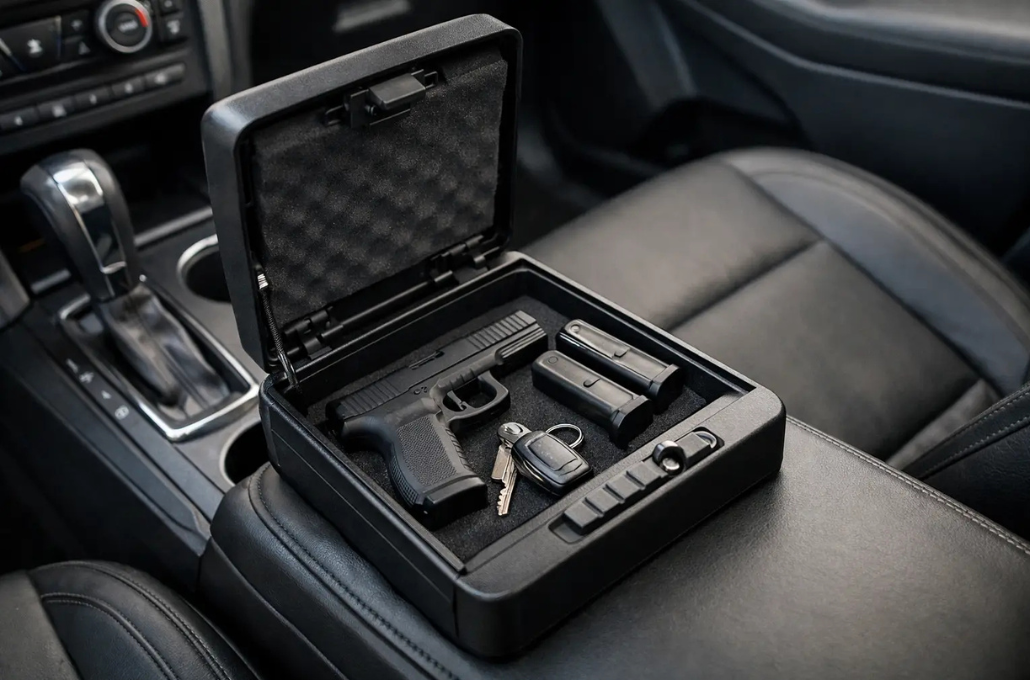
A center console feels convenient right up until you need real security. The problem is simple: a loose pistol in a console is not secure storage, and a cheap lockbox that rattles around is only a small step better. If you are choosing a handgun safe for vehicle console use, the real job is balancing fast access, solid retention, proper fit, and a mounting method that does not fail when it matters.
That balance is what separates a smart purchase from a frustrating one.
What a handgun safe for vehicle console use needs to do
A vehicle safe lives in a harsher environment than a bedside safe. It deals with heat, vibration, tight clearances, awkward reach angles, and the fact that a vehicle is a frequent target for smash-and-grab theft. So the right unit has to do more than lock. It needs to resist quick attacks, stay anchored, and still let you retrieve your handgun without fumbling.
This is where buyers often get tripped up. They focus on the lock first, when fit and mounting usually decide whether the safe will work day to day. A biometric reader sounds attractive, but if the lid hits the console wall or the safe shifts every time you turn, the feature list stops mattering fast.
For most vehicles, the best console-compatible handgun safes share a few traits. They use steel construction rather than thin sheet metal, include a reinforced locking point or pry-resistant door design, and support either bolting or a dedicated cable system that cannot be easily defeated in seconds. They also open in a way that matches the available space inside your console or under a seat.
Size and fit come before brand names
The first question is not which safe is best. It is whether the safe actually fits the console you drive every day.
Vehicle consoles vary more than many buyers expect. A full-size truck may have a deep, wide center console that accepts a compact handgun safe with room to spare. A midsize SUV might narrow sharply at the bottom. A sedan may have a shallow console that looks usable until the lid, hinge, power ports, or tray insert steal half the available space.
Measure the usable interior dimensions, not the exterior console dimensions. Check width at the top and bottom, depth from front to back, and the clearance needed for the safe door or lid to open. If your console has dividers, removable trays, or charging ports, account for them before you compare products.
Also think about the firearm itself. A safe sized for a subcompact pistol may not fit a full-size handgun with an optic, weapon light, or extended magazine. Buyers who plan around the gun alone often forget the added bulk of accessories. A tight fit can slow access or force you to store the handgun in a way that is less consistent.
Lock type depends on how you use the vehicle
There is no universal best lock style for vehicle storage. There is only the best match for your routine.
Keyed lockboxes
A keyed model is simple and often cost-effective. It can work well for temporary storage, especially for drivers who need basic containment and a compact footprint. The trade-off is access speed. Retrieving a key under stress, in low light, or from a seated position is slower than many people expect. It also creates a key management issue, which is easy to underestimate until the wrong person finds it or you misplace it.
Electronic keypad safes
Keypad models are popular because they balance access and security well. A good electronic lock with illuminated buttons can be easier to operate in a vehicle than a key. The main caution is battery dependence and button layout. In a cramped console, small buttons can be harder to use than they look in product photos.
Biometric handgun safes
Biometric access sounds ideal for a vehicle, but quality matters more here than anywhere else. A weak fingerprint reader can turn quick access into repeated failed attempts, especially if your hands are dry, dirty, sweaty, or cold. A strong biometric model with a backup keypad or key override is usually the smarter direction than fingerprint-only access.
If this safe will be used daily, many drivers prefer a keypad or a biometric-plus-keypad combination. If it is more of a compliance and temporary-storage solution, a keyed or basic electronic model may be enough.
Steel thickness, lock strength, and pry resistance matter
A vehicle safe is not a vault, and it should not be marketed like one. But that does not mean all portable handgun safes perform the same.
Look closely at construction details. Heavier steel, better weld quality, reinforced lids, and shielded lock areas all improve resistance to forced entry. Thin, lightly built boxes can be peeled open or twisted apart far more easily than buyers expect. A vehicle thief usually wants speed, so even modest improvements in pry resistance and anchoring can make a major difference.
That is why product specs deserve attention. Steel gauge, hinge design, lock type, and whether the unit includes mounting hardware all tell you more than generic claims like heavy-duty or rugged. For a serious buyer, those details are not marketing filler. They are the difference between secure storage and cosmetic security.
Mounting is where many vehicle safes succeed or fail
Even a well-built safe loses value if it can be removed quickly. A handgun safe for vehicle console storage should be secured in a way that matches both the safe design and the vehicle layout.
Cable-secured options
A steel cable can be practical when permanent installation is not ideal. It is common in portable lockboxes and may be enough for short-term use, travel, or leased vehicles where drilling is off the table. The downside is that cable systems vary widely in quality, and a determined thief with time and tools may defeat a weak setup.
Bolted installation
Bolting the safe to the vehicle structure, console frame, or a dedicated mounting point generally provides better theft resistance. It is the better choice when the safe will remain in the vehicle full time and you want less movement during access. The trade-off is complexity. Installation requires more planning, and you need to avoid interfering with wiring, airbags, seat movement, or console components.
If you are unsure whether a model can be mounted securely in your specific vehicle, this is where a support-first retailer earns its value. Secure Zoned is built around helping buyers match safes to use cases, dimensions, and installation needs rather than forcing a one-size-fits-all answer.
Console safe or under-seat safe?
Sometimes the best handgun safe for vehicle console storage is not actually a console model.
If your console is too tight, blocks door movement, or forces a poor draw angle, an under-seat safe may be the better option. Under-seat units can offer more capacity and easier mounting, especially in trucks and larger SUVs. On the other hand, some drivers prefer console placement because it keeps the firearm more concealed and within a natural reach zone.
This is one of those it-depends decisions. Console placement often wins on discretion and convenience. Under-seat placement often wins on size and installation flexibility. The right answer comes down to your vehicle, your handgun setup, and whether access or concealment is the higher priority.
What to look for when comparing models
At this stage, avoid flashy shortcuts. Compare the things that affect real-world use: interior dimensions, opening direction, lock type, steel construction, mounting method, and whether the unit accommodates your handgun with accessories attached.
It also helps to think about daily friction. Can you open it one-handed from the driver seat if needed? Will the lid clear the console walls? Does the keypad sit where your fingers can reach it naturally? Will summer heat inside the vehicle affect electronics or batteries enough to change your maintenance routine?
A safe that checks every spec box but is awkward to use usually ends up being used poorly or not used at all.
The legal and practical side of vehicle storage
Vehicle gun storage is not just a product decision. It is also a responsibility issue. State and local laws vary, and drivers should know how firearm transport and storage rules apply where they live and travel. A safe supports responsible storage, but it does not replace understanding the law.
From a practical standpoint, the best habit is minimizing unattended firearm time in the vehicle whenever possible. Even a good safe is still being left inside a mobile target. A properly installed safe reduces risk. It does not erase it.
That is why many experienced buyers treat a vehicle safe as a controlled temporary-storage solution, not a permanent home for the firearm.
Choosing the right level of security
Not every buyer needs the same thing. Some want a compact lockbox that keeps a handgun secured during short stops and routine travel. Others want a more substantial unit with better pry resistance, stronger mounting, and quicker access because the firearm moves in and out of the vehicle daily.
The smart purchase is the one that matches the threat level, the vehicle space, and the way you actually use the gun. Buy too small, and access becomes frustrating. Buy too large, and fit becomes the problem. Buy too light, and theft resistance suffers. Buy too complicated, and reliability may suffer.
A good vehicle safe should feel boring in the best way. It fits, it mounts correctly, it opens the way you expect, and it does its job without drama. That is usually the clearest sign you chose well.