
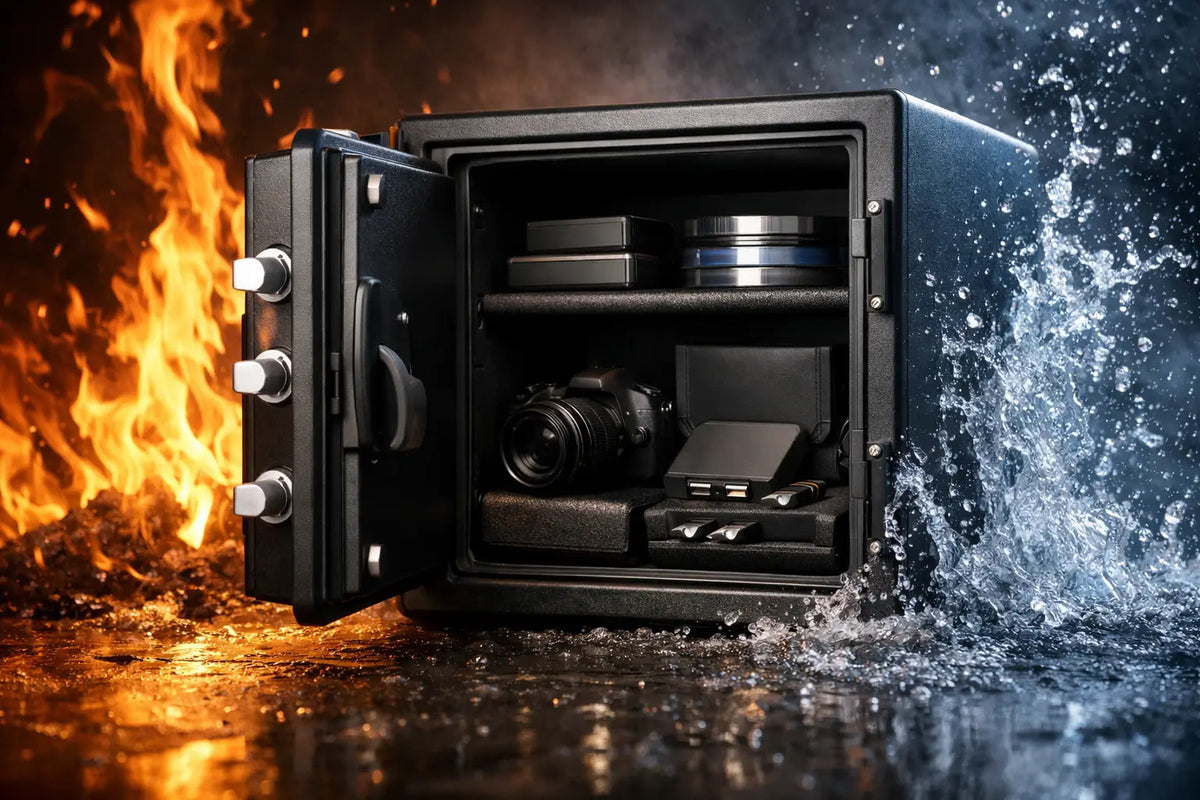
A house fire does not need to burn a hard drive, USB drive, or box of family photos to damage it. Heat that never reaches the outside of a safe can still build inside, while steam and humidity can corrode delicate components. So, can safes protect media? Yes, but only when the safe is specifically designed and rated for the type of media you need to preserve.
A standard fire safe can be an excellent place for paper records, passports, property documents, and cash. It is not automatically the right place for external hard drives, backup tapes, optical discs, film negatives, or flash media. The difference comes down to the temperature and humidity each item can tolerate.
Can Safes Protect Media Better Than a Paper Safe?
Most consumer fire ratings focus on paper. Paper begins to char around 350°F, so a safe tested to keep its interior below that threshold may carry a fire rating suitable for documents. That is meaningful protection for birth certificates, wills, insurance records, and similar items.
Digital media is more sensitive. Magnetic media, optical discs, and many electronic storage devices can fail at temperatures well below 350°F. Heat can distort discs, affect magnetic data, damage plastic housings, and shorten the life of batteries and electronic components. Moisture is another concern. A fire-safe interior can become humid as insulation releases moisture during a fire, which may be acceptable for paper but harmful to electronic media.
That is why a paper fire rating should not be treated as a media rating. A safe can protect both, but the specifications must support both.
What a Media Fire Rating Actually Means
When protecting data, look beyond marketing phrases such as “fireproof” or “fire resistant.” The strongest indicator is an independent test rating that identifies the maximum internal temperature the container maintained during a timed fire test.
UL fire classifications are commonly used as a reference point. Class 350 is intended for paper records. Class 150 is generally associated with magnetic media, such as tapes and certain data cartridges. Class 125 offers a lower internal temperature environment for more sensitive computer media. These classifications can be paired with a time rating, such as one hour or two hours.
The lower the permitted interior temperature, the more demanding the protection standard. A safe labeled for one hour of Class 350 protection is not equivalent to a safe tested to a Class 125 standard for one hour. Both may be fire-rated, but they are engineered for different contents.
For a buyer, the practical question is straightforward: What will be inside the safe? If it is primarily paper, a quality document safe or fire file may be the right answer. If it includes business backups, archived client records, hard drives, or irreplaceable digital family files, seek a media-rated safe or a dedicated media insert with a rating that matches the contents.
Fire Ratings Have Limits
A fire rating is valuable, but it is not a promise that every item will survive every fire. Test conditions are controlled. A real fire can burn longer than the rating period, expose a safe to unusual heat patterns, or cause structural collapse and impact damage.
Placement also matters. A safe in a garage, basement, or exterior wall may face different hazards than one installed in a climate-controlled interior room. A heavy safe that is properly anchored may be less likely to shift during a fire or theft attempt, but anchoring should be completed according to the manufacturer’s instructions so it does not compromise the safe’s intended performance.
Water Resistance Matters After the Fire
The fire department’s response may create the second threat. Water can enter a safe through seams, around a door, or through openings not designed to resist prolonged exposure. Even a safe that keeps temperatures low may not keep contents dry.
Water-resistant models can help protect against sprinklers, hose spray, and short-term standing water, but “water-resistant” and “waterproof” are not interchangeable. Review the stated water test, including the depth and duration, rather than assuming a general water claim will protect a drive during a flooded basement event.
For sensitive media, water protection is especially useful because moisture can do damage after the immediate emergency has passed. If a safe has been exposed to fire, smoke, or water, avoid opening it unnecessarily until conditions are safe. Moving hot contents into cooler, humid air can create condensation. If the media contains critical records, a qualified data recovery professional may be worth contacting before attempting to power up a damaged device.
Choosing the Right Safe for Digital and Physical Records
The best setup is often layered rather than one-size-fits-all. A homeowner may keep original paper documents in a fire-rated document safe, while placing portable drives and backup media in a smaller independently rated media safe inside it. A business may use a fire-rated filing cabinet for records and a dedicated media container for backup drives or tapes.
Before choosing, consider four practical factors:
- The media type: USB drives, solid-state drives, external hard drives, tape backups, discs, photographs, and film each have different vulnerabilities.
- The rating: Match the safe’s tested fire class and duration to the sensitivity of the contents, not just the fact that the product says “fireproof.”
- The location: Consider fire exposure, flood risk, humidity, and whether the safe can be securely anchored in that location.
- The recovery plan: A safe protects one copy, but it should not be the only copy of essential data.
Do Not Store Everything on One Drive
A media-rated safe protects the physical copy in your home or office. It does not protect against accidental deletion, ransomware, hardware failure, or a fire that exceeds the safe’s rating. Critical data should follow a disciplined backup plan with more than one copy stored in more than one place.
For many families, that means keeping a local encrypted backup in a rated safe and a second backup away from the property. For a small business, it may mean rotating encrypted backups off-site, using secure cloud storage, or combining both approaches. The safe remains an important part of the plan because it helps protect the local copy from theft, fire, and water damage, but it should not carry the entire burden.
Common Mistakes When Storing Media in a Safe
The most common mistake is buying a safe based on its exterior appearance or a broad “fireproof” claim. Thick steel, a heavy door, and a reliable lock are excellent burglary deterrents, but burglary protection and media fire protection are separate performance categories. A high-security safe may need a rated media container inside it if its fire specification is designed for paper.
Another mistake is overlooking humidity. Avoid placing damp items in the safe, and use an appropriate moisture-control solution where recommended by the safe manufacturer. Be cautious with rechargeable devices and lithium-ion batteries. They can present their own fire risk, and many safe manufacturers do not recommend storing loose batteries in enclosed fire-resistant containers.
Finally, do not let a safe become a forgotten archive. Check backup drives periodically, confirm files can still be read, and replace aging media before it fails. Protection is more than keeping an item behind steel. It is making sure the information is still usable when you need it.
A well-chosen safe can protect media from the threats that matter most, but the label must match the contents. Select for the actual fire and water performance you need, keep more than one copy of critical data, and give irreplaceable records a protection plan worthy of their value.