
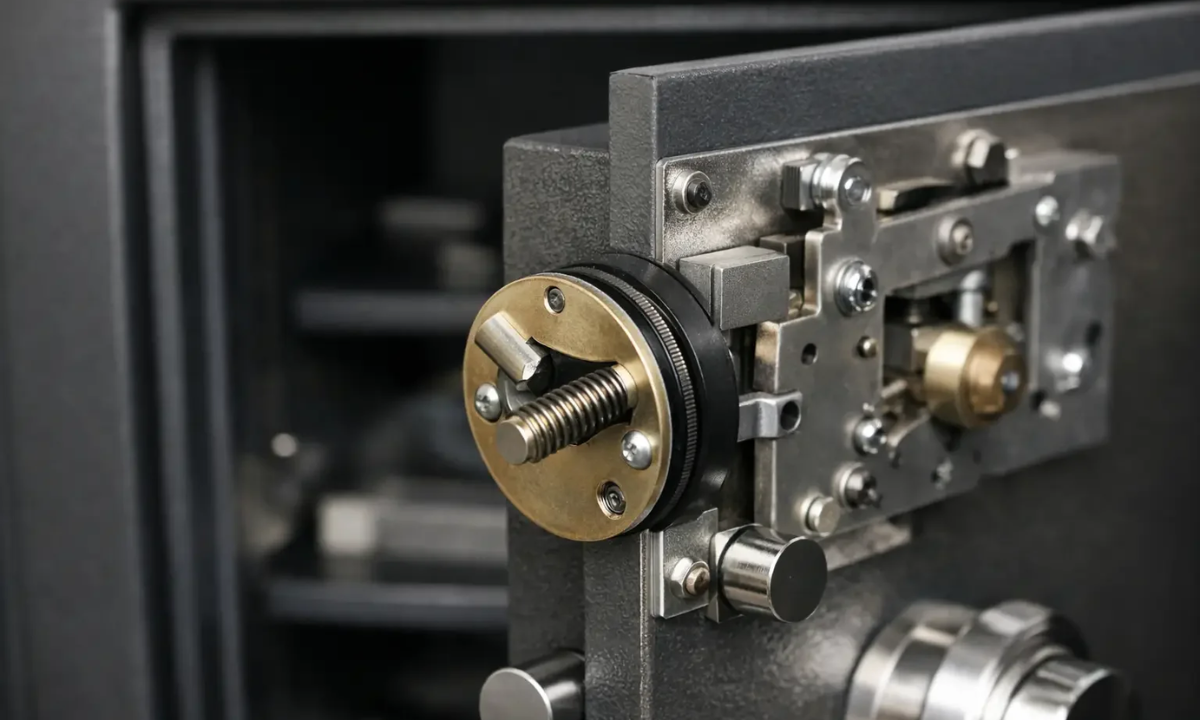
A burglar may attack a safe’s lock, drill through its door, or try to knock the lock mechanism out of position. That is why safes have relockers: they are secondary locking devices designed to keep the door closed when an attack damages or removes the primary lock.
A relocker is not the feature most buyers ask about first. Fire ratings, steel thickness, lock type, and interior capacity usually get more attention. But for a safe intended to protect firearms, cash, jewelry, documents, or business assets against burglary, relockers are a meaningful part of the security story. They add another obstacle at the exact moment an attacker expects the lock to fail.
What Is a Safe Relocker?
A relocker is a spring-loaded pin, bolt, or locking device inside the safe door. Under normal conditions, it stays held in a retracted position by the lock or another component of the lockwork. If that component is drilled, punched, broken, or forcibly displaced, the relocker releases and drives into the boltwork or door frame.
Once triggered, it can prevent the boltwork from retracting even if the attacker removes the lock entirely. In practical terms, defeating the lock does not automatically open the safe.
This is why a relocker should not be confused with the locking bolts visible along the edge of a safe door. The primary bolts secure the door during everyday use. The relocker is a separate, concealed defense intended to activate during a forced-entry attempt.
Why Safes Have Relockers: Time Is the Real Defense
Most burglary attacks are a race against time, noise, and attention. A thief who can quickly manipulate or destroy a lock has a better chance of getting inside before being noticed. A relocker changes that calculation.
If an attack triggers a relocker, the safe may require specialized service, drilling at a different location, or extensive work to open. That delay is valuable. It can discourage the attacker, give alarms or cameras more time to do their job, and increase the chance that someone notices the break-in.
Relockers also address a basic reality of safe construction: the lock is a necessary access point. Even a quality UL-listed electronic or mechanical lock is mounted to the door and connected to internal boltwork. Security engineers use relockers to ensure that a direct attack on that necessary component does not become a shortcut around the rest of the safe.
For a homeowner, this may mean the difference between a thief walking away with a locked safe and getting access to family valuables or firearms. For a business, it can help protect cash drawers, deposits, controlled medications, or sensitive records during an after-hours attack.
How Mechanical and Glass Relockers Work
Not every relocker works the same way. Better safes often use multiple relocking devices because burglars do not all use the same attack method.
Mechanical relockers
A mechanical relocker is commonly held back by a component connected to the lock or boltwork. If drilling destroys that component, the spring-loaded relocker fires into place. Some designs are positioned to respond specifically to attacks on the lock mounting area.
Mechanical relockers are straightforward and proven. They do not depend on batteries, electronics, or a Wi-Fi connection. Their job is purely mechanical: if an attack disrupts the right part, the backup lock engages.
Glass relockers
Glass relockers use a sheet or plate of tempered glass inside the door. Relocking devices are held in place by the glass. A drill attack that reaches and breaks the glass can release one or more relockers.
This design creates a wider defensive zone. Rather than protecting only the lock area, a glass relocker can react when an attacker drills into a protected section of the door. High-security burglary safes and many TL-rated safes may use glass relockers along with other hardplate, barrier material, and anti-drill defenses.
The trade-off is serviceability. If a glass relocker fires, opening and repairing the safe generally requires a qualified safe technician. That is a worthwhile trade-off when the safe is protecting high-value assets, but it reinforces why owners should keep their combination, backup key procedures, and lock maintenance in order.
More Relockers Are Not the Only Measure of Security
It is tempting to compare safes by asking which one has the most relockers. That number matters, but it does not tell the whole story.
A relocker needs a strong door, protected lock area, reliable boltwork, and a body that resists cutting, prying, and drilling. A thin residential security cabinet with several relockers is not automatically more secure than a well-built burglary safe with fewer, properly placed devices. Likewise, a high-quality lock alone does not make a light safe resistant to pry attacks.
Look at the complete construction package: steel thickness, door design, bolt coverage, lock listing, hardplate or drill-resistant material, anchoring provisions, weight, and independent burglary ratings where applicable. A TL-15 or TL-30 safe is evaluated as a system under concentrated tool attacks. Its relockers are part of that system, not a standalone selling point.
For many gun safe buyers, relockers are a valuable added layer, particularly on heavier models with stronger door construction and anchor holes. For jewelry, cash, or collectible assets with a higher theft risk, a burglary-rated safe may be the better fit than choosing based on fire protection alone.
Fire Rating and Relockers Protect Against Different Risks
A common buying mistake is assuming that a fireproof safe is automatically a burglary-resistant safe. These are separate performance questions.
A fire rating addresses how long the safe can help protect its contents from heat, often under a stated test temperature and duration. It is especially relevant for paper records, heirlooms, and certain valuables. A relocker addresses forced entry after a lock-area attack.
Some safes offer both fire protection and anti-theft features, but the strength of each varies by model. A document safe designed mainly for fire protection may have limited burglary resistance. A commercial burglary safe may prioritize tool resistance and relocking systems over a long fire rating. The right choice depends on what you are protecting and the risk at the installation location.
For example, a homeowner storing passports and legal papers may prioritize fire protection, water resistance, and secure anchoring. A retail owner holding daily deposits needs a safe designed for cash handling and burglary resistance, often with a depository feature that allows employees to make deposits without opening the main compartment.
What Happens If a Relocker Activates?
A properly triggered relocker does exactly what it is supposed to do: it prevents normal opening. Unfortunately, that can also happen after a severe lock failure, an improper repair attempt, or an accidental drilling mistake.
Do not try to force the handle, pry the door, or drill a safe yourself if you suspect a relocker has fired. Those actions can cause more damage and may make professional opening more difficult. Contact a qualified safe technician who understands the safe’s lockwork and relocking layout.
This is also one reason to buy from a knowledgeable safe retailer and choose a safe suited to the job. Before delivery, think through placement, anchoring, access control, and who will be responsible for the combination or electronic lock code. A safe is far easier to use securely when those decisions are made before it is loaded.
Choosing a Safe With the Right Level of Protection
Relockers deserve attention when theft resistance is a priority, but the right level depends on your situation. A bedside handgun safe is usually selected for quick, responsible access and secure mounting. A full-size gun safe should balance firearm capacity, fire protection, lock quality, boltwork, and anchoring. A business safe may need burglary protection, deposit access, and a serviceable commercial lock.
Ask how the safe is constructed around the lock, whether it includes active relockers, and whether it has a recognized burglary rating if you are protecting high-value items. Then consider the installation. Even a strong safe benefits from being securely anchored to a suitable floor or structural surface. Anchoring makes removal harder, and removal is often the first step in an off-site attack.
A relocker is not a feature you will see working during normal ownership. That is the point. It stays hidden until someone tries to defeat the safe by force, adding a critical barrier between an attacker and what matters most.