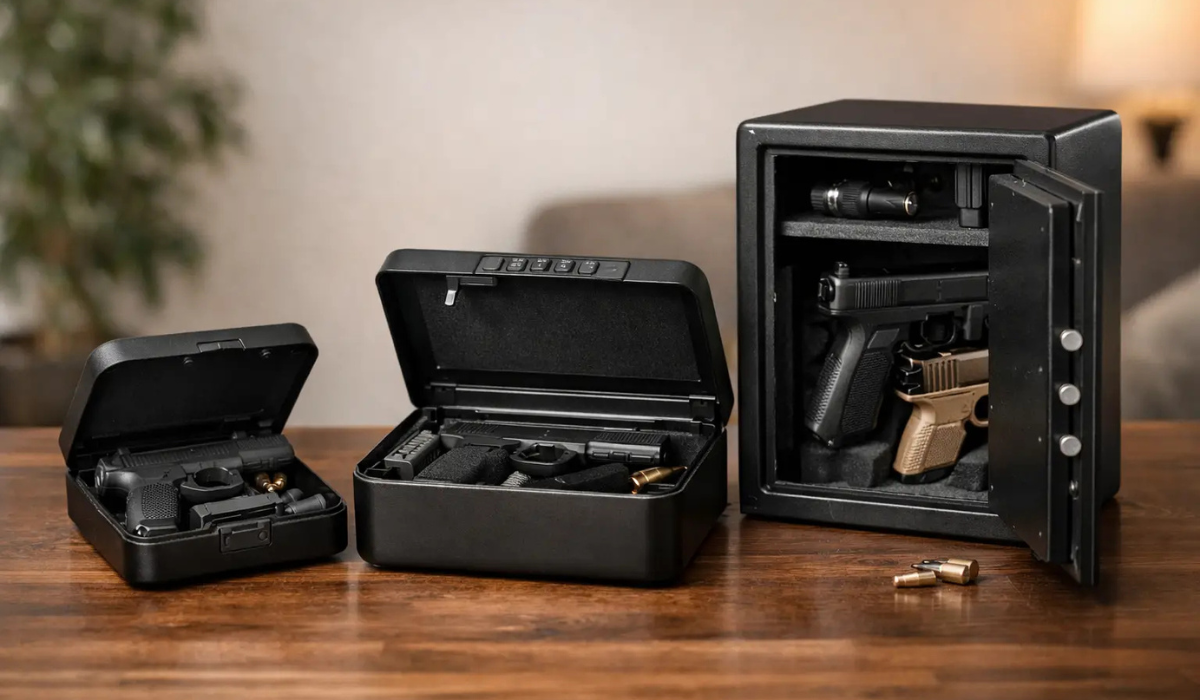
A handgun safe that is too small usually fails in the same way - the pistol fits on day one, then a light, spare magazine, or second handgun turns that "perfect" size into a frustrating squeeze. A safe that is too large can be just as problematic if it no longer fits your nightstand, closet shelf, vehicle space, or mounting location. If you're figuring out how to choose handgun safe size, the right answer starts with how you actually use the firearm, not just the dimensions listed on the box.
For most buyers, size is really about balancing three things: secure fit, quick access, and room for the setup you will realistically store over the next few years. That balance looks different for someone storing one bedside pistol than it does for a household securing two handguns, passports, and spare magazines.
How to choose handgun safe size for your setup
Start with the handgun itself, but do not stop there. Manufacturer dimensions tell you the overall length and height of the pistol, yet the usable interior of a safe is shaped by foam, hinges, lock housings, and door swing. That means a safe advertised to fit a full-size handgun may technically hold it, but not comfortably if the pistol has a red dot, weapon light, threaded barrel, or extended magazine.
A better way to think about fit is in layers. First, measure the handgun in the exact condition you plan to store it. If it wears a mounted light, optic, or suppressor-height sights, measure it that way. Then account for clearance. You want enough room to place and retrieve the firearm without snagging the grip or banging the optic against the interior.
For a single handgun, a close-fitting safe can make sense when space is limited and the goal is fast access. For two or more handguns, or one handgun plus accessories, a compact model often becomes cramped quickly. Buyers regularly underestimate how much space spare magazines, a flashlight, documents, or a second key fob can take up inside a small box.
Interior dimensions matter more than exterior dimensions
This is where many shoppers get tripped up. Exterior dimensions tell you whether the safe fits in your drawer, on your shelf, or beside the bed. Interior dimensions tell you whether your handgun actually fits inside in a usable way. Both matter, but if you are choosing between models, interior space is usually the deciding factor.
The door and locking mechanism can reduce usable space more than expected. A safe with thick steel construction and a substantial lock body may offer excellent security, but some of that bulk comes out of the interior. Foam padding also protects the handgun, though it can slightly tighten the fit. That is not a flaw - it just means published capacity claims should be treated as a starting point, not a guarantee.
If you are comparing safes online, look for interior dimensions first and then mentally subtract a little room for comfort. A handgun should go in and come out cleanly under stress. If the listed interior size suggests a very tight fit, moving up one size is often the smarter call.
Think beyond the pistol alone
A bedside handgun safe often ends up storing more than a handgun. Many owners want space for one or two spare magazines, a small flashlight, or a wallet. Some also keep personal documents, medication, or car keys inside. None of those items are large on their own, but together they can turn a one-gun safe into an overstuffed container.
That matters for access. Quick-access safes work best when the handgun is easy to grab immediately. If loose gear shifts around and blocks the grip, the safe may still be secure, but it is no longer optimized for its main job.
Matching safe size to where it will live
The best handgun safe size is also shaped by installation. A compact safe may be ideal for a nightstand drawer, while a larger unit may work better bolted in a closet, under a bed platform, or inside a vehicle console area. The right size is not always the biggest safe you can afford. It is the one that fits the available space without compromising access or mounting.
If the safe will be mounted, measure the exact footprint of the location and leave room for the door to open fully. This is easy to overlook. A safe may physically fit on a shelf, but if the door cannot swing open because of a wall, bed frame, or drawer edge, everyday use becomes awkward.
Weight matters too. A heavier handgun safe can offer better theft resistance, especially when paired with solid mounting, but it may not work well in lightweight furniture. Small portable safes have their place for travel or temporary use, yet they involve trade-offs in capacity and burglary resistance. If the safe is meant to be your primary home storage solution, portability should not come at the expense of real-world security.
Bedroom, vehicle, and closet setups need different sizes
For a bedroom setup, low-profile dimensions often matter as much as interior room. Buyers usually want something that fits a nightstand shelf or drawer while still allowing a natural hand position on retrieval. In that case, shallow height and enough grip clearance are more important than extra unused interior volume.
For vehicle storage, external size becomes even more restrictive. A safe that is technically large enough for the gun may be too bulky for practical placement under a seat or inside a console area. Here, measuring the vehicle space first can save a lot of frustration.
For closet or cabinet placement, you typically have more flexibility. That makes it a good option if you want room for multiple handguns or extra valuables without crowding the interior.
Plan for your next handgun, not just your current one
One of the most common sizing mistakes is buying strictly for today's needs. If you own one compact pistol now but plan to add a full-size handgun later, or if another responsible adult in the home may need storage space too, a slightly larger safe often delivers better long-term value.
This does not mean everyone should oversize dramatically. A massive safe for one carry pistol can be inconvenient and wasteful. But moving from a one-gun footprint to a two-gun-capable interior is often a practical upgrade. It gives you flexibility for accessories, future purchases, and less cramped access.
There is also a difference between stated capacity and comfortable capacity. A safe marketed for two handguns may fit two slim pistols with minimal extras. If one is a full-size model with an optic and the other has a weapon light, usable capacity may feel closer to one-and-a-half guns. That is why real dimensions and actual storage habits matter more than marketing labels.
Security features can affect sizing decisions
Not all size decisions are about storage volume. The lock type, steel thickness, pry resistance, and mounting options all affect how the safe performs. In some cases, buyers focus so much on getting the smallest possible footprint that they end up with a model that gives up too much in security or durability.
A biometric safe may need interior and top-side space for its lock housing. A mechanical simplex-style lock can be extremely reliable for quick access, but the safe's body dimensions may be shaped differently because of the lock design. Electronic keypad models vary as well. None of this is inherently better or worse - it just means safe size should be considered alongside the security features you actually want.
If child resistance and theft deterrence are the priority, do not judge a safe on footprint alone. A slightly larger model with better mounting capability and stronger construction may be the safer choice, even if it takes up more room.
A practical way to choose the right size
If you want a simple approach to how to choose handgun safe size, picture the exact loadout you plan to store for the next two to three years. Measure the handgun with all installed accessories. Decide whether spare magazines or personal items belong inside. Measure the intended location, including clearance for the door. Then compare those numbers to the interior dimensions first and the exterior dimensions second.
If the fit looks exact on paper, size up one step. That small buffer usually improves day-to-day use more than buyers expect. It gives you smoother access, less wear on optics and finishes, and enough flexibility if your setup changes.
At Secure Zoned, this is the kind of decision where specs should make the choice easier, not more confusing. A good handgun safe is not just one that can hold your firearm. It is one that fits your handgun, your space, and your routine well enough that you will use it every single time.