
A birth certificate curled by basement humidity is frustrating. A hard drive full of scans does not fix the original once it is water-stained, scorched, or missing. If you are figuring out how to store paper documents, the real goal is not just neat filing. It is making sure the documents you may need most are protected, easy to find, and still readable years from now.
Some papers can be replaced with time and fees. Others are much harder to recover, especially if they involve legal records, family history, business compliance, or original signatures. That is why good document storage is less about office supplies and more about risk management.
How to store paper documents without ruining them
Paper is more fragile than it looks. Heat, moisture, light, pests, and poor handling all do damage slowly. The trouble is that most of that damage happens quietly. You usually do not notice a problem until ink starts fading, pages begin sticking together, or a folder smells musty.
The safest approach starts with sorting documents by importance. Everyday papers like utility bills and old school flyers do not need the same protection as passports, titles, wills, insurance records, tax returns, stock certificates, or business formation documents. When everything is treated the same, truly critical items often end up underprotected.
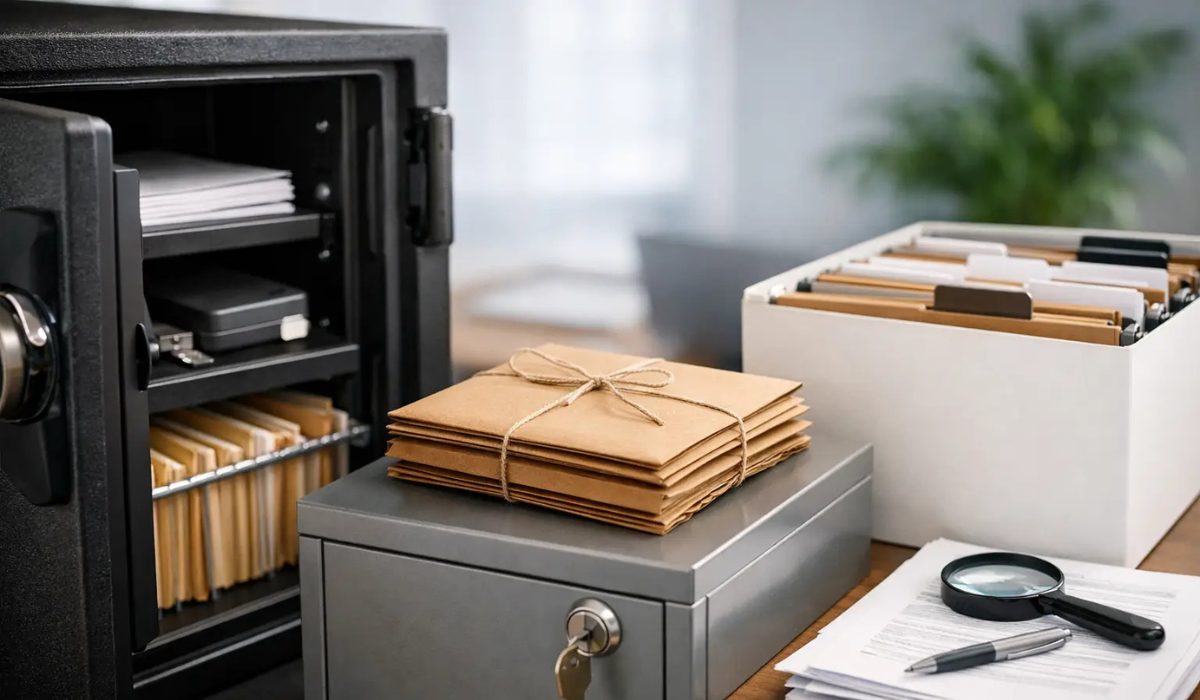
A good system has three layers. First, organize documents so they are easy to access. Second, protect them from environmental damage. Third, place the most important originals inside a fire-resistant and water-resistant container or safe. That combination works better than relying on a desk drawer, cardboard box, or plastic tote alone.
Start by separating replaceable from irreplaceable
Before you buy folders or a safe, decide what deserves premium protection. This is where most people save time and money. Not every paper has to live in a fire-rated safe, but the wrong few left out can cause the biggest headache.
Irreplaceable or high-friction documents usually include birth certificates, Social Security cards, passports, marriage licenses, divorce decrees, property deeds, vehicle titles, wills, trusts, power of attorney documents, estate paperwork, military service records, and original business licenses. For small businesses, payroll records, tax filings, insurance policies, vendor contracts, employee records, and banking documents may also belong in protected storage, depending on your retention requirements.
Replaceable papers can usually live in a standard filing cabinet or organized file box, as long as the storage area is clean and dry. Think appliance manuals, paid utility statements, and routine correspondence you can download or request again.
This is also a smart time to reduce clutter. Keeping too much paper increases the odds of misfiling something important. Shred what you no longer need, especially anything with account numbers, signatures, or personal data.
Choose the right storage spot first
Even the best container performs worse in the wrong location. Garages, attics, sheds, and unfinished basements are common problem areas because temperatures swing hard and humidity creeps in. Paper absorbs moisture from the air, which can lead to warping, mold, and stuck pages. Extreme heat also makes paper brittle over time.
The better choice is a climate-controlled interior space. A bedroom closet, home office, interior storage room, or secured office area is usually safer than anywhere exposed to outdoor conditions. Keep documents off the floor in case of minor leaks or spills. Even a few inches of elevation helps.
For businesses, document storage should also reflect access control. If multiple employees can reach a file cabinet, sensitive papers are more exposed to loss or mishandling. A locking cabinet may be enough for lower-risk files, but records tied to compliance, identity, payroll, or cash handling usually deserve a higher level of physical security.
The containers matter more than most people think
If you want to know how to store paper documents for long-term protection, avoid stuffing them loosely into boxes, binders with rusty hardware, or cheap plastic sleeves that trap moisture. Use acid-free folders for important documents when possible, especially for records you expect to keep for decades. Standard manila folders are fine for routine files, but archival-safe materials are better for heirloom documents and old family records.
Keep pages flat. Folding legal documents, certificates, and titles can weaken them at the crease and make them harder to scan or copy later. Use labeled folders and clearly named categories so retrieval is quick. The more time you spend digging through paper, the more likely you are to bend, tear, or misplace something.
Plastic bins are popular, but they are not automatically ideal. They help with dust and casual splashes, yet they are not a substitute for fire protection and can trap humidity if documents go in damp or if the storage area is humid. For lower-priority paper archives, they can be useful in a conditioned room. For critical originals, a rated safe is the better answer.
Fire protection changes the equation
House fires and office fires are low-frequency events, but the damage is catastrophic when they happen. That is why fire resistance matters so much for paper storage. It is one of the few threats that can destroy everything in minutes.
A basic lockbox may help with casual organization, but it usually does very little in a real fire. If you are protecting legal records, family documents, or business paperwork, look for a safe or file cabinet with a verified fire rating designed for paper documents. Ratings vary, and the details matter. A safe rated for one hour or two hours at a specified temperature gives you a clearer idea of what it is built to withstand.
There is a trade-off here. Smaller document chests are convenient and less expensive, but they may hold less, offer lighter burglary protection, or be easier to carry off if they are not secured. Larger fireproof safes and fire file cabinets offer more capacity and often stronger construction, but they take up space and weigh significantly more. The right choice depends on whether your main concern is document volume, fire exposure, theft risk, or all three.
For many households, the best setup is a fire-rated home safe for the most critical originals plus a simple filing system for less-sensitive papers. For a business, a fire-rated file cabinet or commercial safe may make more sense because records are accessed more often and volumes are higher.
Water resistance is not the same as waterproof
People often focus on fire and forget water. That is a mistake. Fire response usually involves water, and everyday risks like leaks, burst pipes, and storm intrusion are far more common than full structure fires.
Some safes are fire-rated but not meaningfully water-resistant. Others offer water protection for a limited period or under certain conditions. That is why reading the actual specifications matters. If your document storage area is near plumbing, below grade, or in a region where storms are a serious concern, water resistance deserves more weight in your decision.
Still, no safe solves every scenario. If your home or business is in a flood-prone area, placement matters just as much as product specs. Keeping a safe above ground level or on a raised platform can reduce exposure.
Organization is part of security
A messy filing system creates its own risk. If you cannot find a title, insurance policy, or contract when you need it, the paper is effectively lost even if it still exists.
Group documents by type and urgency. Personal identity records, property records, financial records, legal papers, medical records, and business documents should each have their own section. Within those sections, date order usually works best. Use labels that make sense at a glance, not labels you need to decode later.
It also helps to create a short inventory of what is in your protected storage. You do not need anything complicated. A single page listing the contents of your safe or document drawer can save time during an emergency, insurance claim, or estate planning process.
Scanning helps, but it does not replace originals
Digital backups are useful, especially for quick access and redundancy. Scan your critical documents and store them securely, but do not assume the scan makes the original unnecessary. Many agencies, lenders, courts, and insurers still want the original or a certified copy.
Think of scanning as a second layer of protection. If the original is damaged, a digital copy can speed up replacement and prove what you had. But if the document is hard to reissue, the original still deserves physical protection.
When a safe is the right answer
If you are storing a handful of passports and certificates, a compact fire-rated document safe may be enough. If you are protecting estate documents, family records, cash, jewelry, backup drives, and paper files together, a larger home safe is often the better fit. For offices and retail businesses, daily access patterns matter. A fire file cabinet may be more practical than stacking folders inside a burglary safe if staff needs frequent retrieval.
This is where specs should guide the choice. Fire rating, lock type, interior dimensions, weight, steel construction, and anchoring options all affect real-world performance. A safe that is excellent for paper protection may not be the best choice for frequent access, and a light document box may be easy to use but easier to remove. It depends on what you are protecting and who needs access.
The best storage system is the one you will actually use consistently. If your documents are important enough to worry about, they are important enough to store with intention. Protect the originals, keep them organized, and give them a level of fire and water protection that matches what it would cost to lose them.