
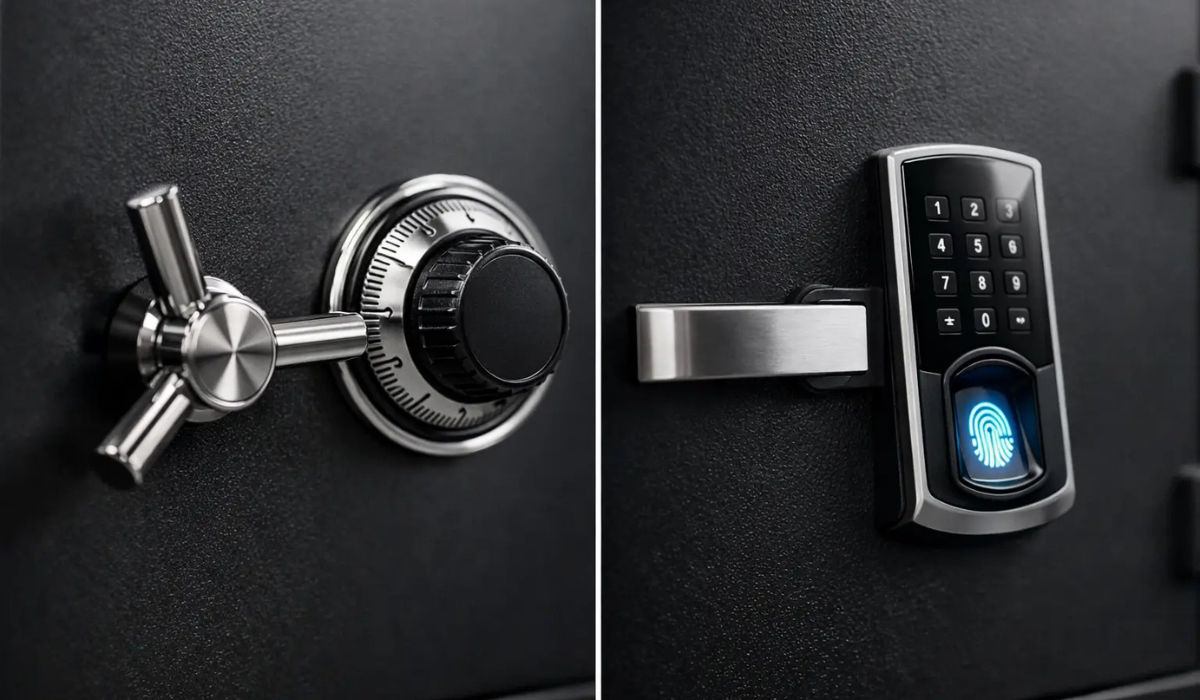
A lock choice usually feels small right up until you need the safe open fast. That is why the mechanical lock vs biometric question matters so much for handgun safes, home safes, and business cash storage. The right answer depends less on trends and more on how you use the safe, where it sits, and what you are trying to protect.
Some buyers come in assuming biometric is automatically better because it is newer. Others trust only a traditional mechanical lock because it has been around for decades. Both views miss the bigger point. A lock is only a good fit if it matches the real-world job the safe has to do.
Mechanical lock vs biometric: the real difference
At the simplest level, a mechanical lock relies on physical components and a manual opening process. That might mean a dial combination lock or a Simplex-style mechanical pushbutton lock, depending on the safe. A biometric lock uses a fingerprint reader and electronic components to verify the user before opening.
That difference affects more than convenience. It changes opening speed, battery dependence, long-term maintenance, and how the safe performs under stress. If you need access in the dark, under pressure, or one-handed, a biometric safe may feel like the obvious winner. If you care most about long-term reliability with fewer electronic failure points, a mechanical option has a strong case.
Neither is universally best. The better question is which trade-off you are more comfortable making.
Where biometric locks make the most sense
Biometric safes are popular for a reason. They are fast, simple to use once programmed correctly, and practical for quick-access situations. For many handgun owners, that speed is the whole point. If a safe is there to keep unauthorized hands out while still giving you rapid access, a fingerprint reader can be a very useful feature.
That is especially true in bedside setups, closets, or other places where you may need to get in without fumbling with a dial or remembering a combination under stress. Many modern biometric handgun safes can store multiple fingerprints, which helps for households with more than one authorized user.
For some business uses, biometric access also adds accountability and control. It can limit access to a smaller group without passing around combinations or keys. In an office, pharmacy, or cash-handling environment, that can be helpful when access needs to stay tight.
Still, biometric performance depends heavily on the quality of the lock. Fingerprint readers are not all equal. A well-made biometric system from a reputable safe brand is a very different experience from a low-end unit with inconsistent reads and flimsy construction.
The strengths of biometric access
The biggest advantage is speed. A good reader can open the safe in seconds. That makes a meaningful difference for quick-access handgun safes and other situations where every second counts.
Biometric locks are also easy for many users to live with day to day. You do not have to spin a dial accurately or memorize a lengthy code. For households that want simple operation, that ease matters.
Some buyers also like that fingerprints cannot be casually shared the way a written code can. While no lock type is perfect, biometric access can reduce the odds of someone learning your combination through poor storage habits.
The trade-offs with biometric safes
Biometric locks need power. That usually means batteries, and batteries eventually need replacing. Most quality biometric safes include backup entry methods, but power dependence is still part of the equation.
Fingerprint readers can also be less consistent if fingers are wet, dirty, gloved, or positioned poorly. That does not make biometric locks bad. It just means they need realistic expectations. In a clean home environment, they may work very well. In a dusty garage, a workshop, or a commercial setting with frequent hand wear, performance may be less predictable.
There is also a durability question. Electronic components can be reliable, but they introduce more potential failure points than a purely mechanical system. That is one reason many buyers want an override option or a secondary access method.
Why mechanical locks still have a loyal following
Mechanical locks remain popular because they are proven. A quality mechanical lock does not rely on batteries, fingerprint sensors, or electronic boards. For buyers who want a lock system with fewer variables, that simplicity is reassuring.
This matters even more on larger safes used for long-term storage. If you are securing important documents, jewelry, heirlooms, firearms, or business records, you may value reliability over speed. A lock that opens the same way year after year without worrying about battery life can be a strong advantage.
Mechanical locks also tend to appeal to buyers who care about service life. On many traditional safes, especially heavier home and gun safes, mechanical dial locks have a long track record. They are familiar, widely trusted, and often associated with serious burglary protection when paired with solid safe construction.
The strengths of mechanical access
The first advantage is independence from power. There is no battery schedule to remember and no electronic reader to maintain. That can be a big plus for a safe that may sit closed for weeks or months at a time.
Mechanical locks also have a reputation for consistency over the long haul. When properly made and properly used, they offer steady operation with minimal complication.
For some users, there is another benefit that matters just as much: predictability. A mechanical process is less likely to vary because of finger condition, reader cleanliness, or sensor quality.
The trade-offs with mechanical safes
The main drawback is speed. A dial lock is slower than a fingerprint reader, full stop. Under pressure, especially at night, that can be frustrating for a quick-access use case.
Mechanical locks can also have a learning curve. Dialing accurately takes some practice, and not everyone wants that on a bedside safe. If several family members need authorized access, a shared combination may also feel less controlled than individual biometric enrollment.
It is worth noting that “mechanical” can mean more than one design. A mechanical pushbutton lock is very different from a traditional dial. Some pushbutton systems offer faster access while keeping the no-battery appeal, so they are worth considering if you want a middle ground.
Mechanical lock vs biometric for different safe types
For handgun safes, biometric often has the edge when speed is the priority. If the safe is intended for defensive access while keeping children or unauthorized users out, a quality biometric model can be a smart fit. Just make sure it includes a dependable backup entry method and comes from a brand known for solid lock performance.
For full-size gun safes, the answer is less automatic. Many owners open these safes less often, and the contents are usually broader than one defensive handgun. In that case, long-term reliability may matter more than split-second access. A mechanical lock or a high-quality electronic lock can both make sense, depending on the setup.
For home safes protecting documents, jewelry, and family valuables, think about usage frequency. If you access the safe often, convenience matters. If it is mainly for secure storage and fire protection, a mechanical lock can be a very comfortable choice.
For business safes, the best answer depends on who needs access and how often. A depository safe in a retail setting has different needs than an office document safe. If multiple employees require controlled access, biometric features may help. If the goal is stable, low-maintenance security in a fixed routine, mechanical may be preferable.
What matters more than the lock alone
Buyers sometimes focus so hard on the lock type that they forget the safe body matters just as much, often more. A weak safe with an impressive lock is still a weak safe.
Pay attention to steel thickness, bolt work, relockers, pry resistance, anchoring capability, and fire rating if fire protection is part of the job. For burglary protection, recognized standards and construction details tell you more than marketing language. For larger investments, UL-listed locks and established safe brands are worth the attention.
A biometric lock on a thin, lightweight box is not the same thing as a biometric lock on a well-built safe. The same goes for mechanical locks. The lock should support the safe’s purpose, not distract from the rest of the build.
How to choose with confidence
If your top priority is quick handgun access, biometric is often the better fit, provided the lock is from a reputable manufacturer and you are comfortable maintaining batteries and testing it regularly.
If your top priority is long-term dependability with fewer electronic variables, mechanical is hard to argue against. That is especially true for larger safes used for storage rather than emergency access.
If you are stuck between the two, start with one honest question: what will annoy you more, a slower opening process or occasional electronic upkeep? That usually gets buyers closer to the right answer than any feature sheet.
The best safe is not the one with the newest lock. It is the one you can trust to protect what matters most and open the way you need it to when the moment comes.