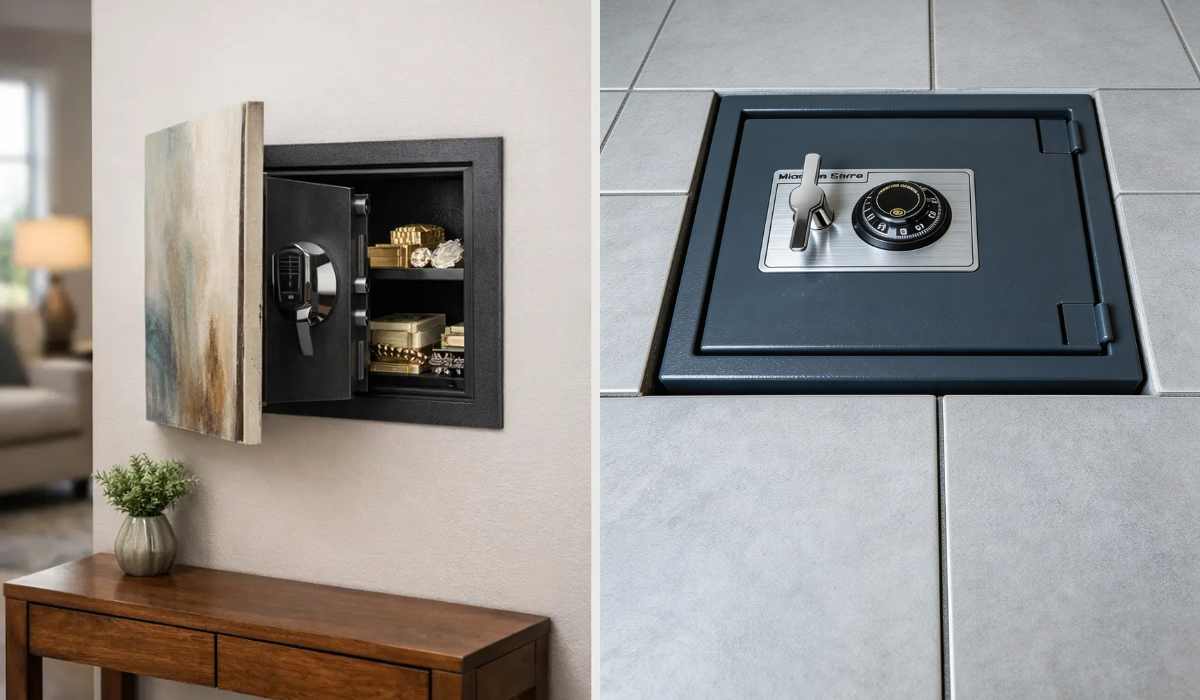
A safe that disappears behind a painting sounds ideal until you need more depth, more fire protection, or a better anchor point. That is where the real in wall safe vs floor safe decision starts - not with looks, but with what you need to protect, how your space is built, and how much risk you are trying to reduce.
For many buyers, both options feel similar at first. They are both built to stay out of sight, both can work well in a home or light commercial setting, and both are often chosen for cash, jewelry, documents, and small valuables. But they behave very differently once you factor in installation limits, burglary resistance, water exposure, and day-to-day access.
In wall safe vs floor safe: the core difference
An in-wall safe installs between wall studs, usually behind furniture, artwork, or inside a closet. Its biggest advantage is concealment. When properly placed, it is harder for a casual intruder to spot, and it preserves floor space.
A floor safe is set into concrete, typically flush with the floor surface. Its biggest advantage is anchoring strength. Once installed correctly, a floor safe is extremely difficult to remove because the surrounding concrete becomes part of the security equation.
That difference matters. If your top priority is keeping the safe hidden from quick smash-and-grab theft, a wall unit has appeal. If your top priority is making forced removal much harder, a floor model usually has the edge.
Where an in-wall safe makes more sense
In-wall safes are often a strong fit for homeowners who want discreet storage without adding a visible box to a room. They work well for passports, backup cash, jewelry, small handguns where legally appropriate, and documents that do not require oversized storage depth.
The main benefit is how naturally they blend into a finished space. A properly installed wall safe behind a framed piece of art or inside a closet can stay out of view during everyday activity, service visits, or open-house traffic. For families trying to secure a few critical items without changing the look of a bedroom or office, that is a practical advantage.
Access is another reason buyers choose them. Because the door is vertical and usually positioned at a comfortable height, wall safes can be easier to open and organize than a safe recessed into the floor. You are not kneeling over it or moving a rug every time you need something.
The trade-off is size. Most interior residential walls are framed with standard stud spacing, and depth is limited by wall construction. That means you are working within tighter dimensions from the start. If you want to store bulky binders, larger cash trays, or high-capacity valuables, an in-wall safe can feel restrictive fast.
Where a floor safe has the advantage
Floor safes are built for a different kind of protection strategy. Because they are installed into concrete, they benefit from very strong anchoring and low visibility. A thief cannot simply tip one over or carry it out the way they might with a poorly installed lightweight safe.
This is why floor safes are often favored for cash, jewelry, sensitive records, and compact valuables in homes, retail environments, and offices. They are especially useful when a buyer is concerned about safe removal as much as lock attack.
A floor safe also avoids one common wall-safe limit: stud spacing. You still need to work within the model's dimensions and the slab depth available, but you are not confined to the narrow cavity inside a wall. Some floor safes provide better internal depth for stacked valuables or deposit use.
That said, floor safes have their own compromise. Access is less convenient. You may need to lift carpet, move a cover, or kneel to reach contents. For items used often, that can become annoying. They also require more planning during installation, especially if the slab is already in place.
Security and theft resistance
If we strip the comparison down to burglary concerns, floor safes usually win on resistance to removal. Concrete installation makes pry-and-carry theft much more difficult. That does not mean the safe is attack-proof, but it changes the attacker's options and increases effort.
In-wall safes rely more heavily on concealment and proper mounting. A quality model installed correctly can still provide meaningful protection, but the wall itself is not the same structural defense as concrete. If a burglar finds it and has time, the surrounding wall area may present more vulnerability than a recessed floor installation.
This is where shopping by specs matters. Steel thickness, door construction, boltwork, lock quality, relockers, and anchoring design all matter more than the category name alone. A cheap floor safe is not automatically better than a well-built wall safe. But comparing two similarly built units, the floor safe often has the stronger anti-removal position.
Fire and water concerns are not equal
Many buyers focus on burglary first and regret it later. Fire and water exposure can be just as damaging, especially for documents, family records, backup media, and estate paperwork.
In-wall safes are not typically the first choice when fire protection is the main priority. Interior walls can be exposed quickly in a house fire, and many recessed wall models are designed more for concealment than for serious fire ratings. There are exceptions, but buyers need to check the actual fire label, test standard, and duration instead of assuming protection.
Floor safes can face a different problem: water. If the safe sits below grade or in an area vulnerable to flooding, plumbing leaks, or slab moisture, contents may be at greater risk unless the unit is specifically designed to resist water intrusion and contents are stored appropriately.
So the better answer depends on the threat profile. For a dry location where anti-removal matters most, floor safes are compelling. For an interior closet on an upper level where concealment matters most, a wall safe may be the cleaner fit. For paper records with strong fire concerns, some buyers are better served by looking beyond both categories to a dedicated fire-rated safe.
Installation is where many decisions get made
A wall safe sounds simple until framing, wiring, and pipe locations enter the picture. Stud placement controls width. Wall depth controls body size. Exterior walls can introduce insulation and temperature concerns. You also want to avoid obvious locations that a burglar would check first, such as the main bedroom closet at eye level.
A floor safe needs a more committed installation path. In new construction, it is easier to plan. In an existing slab, cutting and setting the safe correctly takes more effort and usually professional help. Done right, the result is strong. Done poorly, it creates security and moisture problems.
This is why installation should be part of the buying decision, not an afterthought. If your home layout makes a proper wall installation difficult, the better category on paper may be the worse one in practice. The same is true for floor safes in homes where concrete work is unrealistic.
Which one is better for your use case?
If you want hidden storage for a few valuables and easy access in a finished room, an in-wall safe is often the better fit. It supports low-profile protection and keeps your storage out of plain sight.
If you want stronger resistance to safe removal and are willing to invest in a more involved installation, a floor safe is often the stronger choice. It is particularly useful for cash-heavy households, high-value jewelry, and spaces where concealment plus concrete anchoring adds real security value.
For firearms, the answer depends on the firearm type, local law, and intended use. A wall or floor safe can work for compact handgun storage in the right model, but many gun owners need quicker access, larger capacity, or dedicated firearm-specific features that point to another safe category entirely.
For business use, floor safes often make more sense where cash retention and anti-removal matter. For office document concealment, a wall safe may still be practical if size limits are acceptable.
How to make the right call
The best purchase usually comes from asking four questions before comparing brands or lock styles. What are you protecting? How often do you need access? What is the biggest threat - theft, fire, or water? And what kind of installation can your property actually support?
Those answers tend to narrow the field quickly. If the safe must disappear into a finished room and hold only a focused set of valuables, wall installation is appealing. If you care most about making removal extremely difficult, floor installation deserves serious attention.
At Secure Zoned, that is usually where the conversation becomes more productive - not wall versus floor in the abstract, but matching safe design to the item, the location, and the real-world risk.
A safe works best when it fits the structure around it as well as the valuables inside it, so choose the one that protects your weak points instead of just the one that hides the best.